THUS SPOKE MY OLD MAN !
Welcome to the Idle Words Said in Passing!
The Travails of a Senior Golfer - My Old Man at Play
Playing a Difficult Course

My Old Man at Play
There he goes again, my Old Man, taking on a difficult golf course. Of course he is. He is a little stubborn, if not downright wilful. And a high-handicapper tackling a difficult course is not always a pretty sight. His handicap, high as it may be, did little to save him from the inevitable. He did not play well. At one point, he threw his hands in the air and declared, with a mixture of frustration and amusement: "Bad golf course design, made to frustrate senior golfers!"
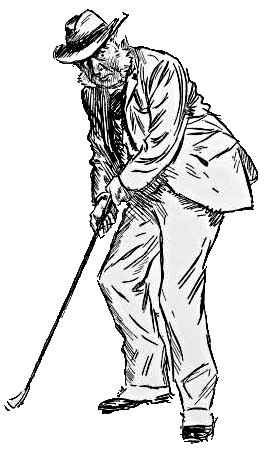 He can find something to complain about for he is quite analytical
much of the time, but perhaps this time he had a point. He laughed! A good laugh is never wasted, and that is very much the nature of my Old Man
He can find something to complain about for he is quite analytical
much of the time, but perhaps this time he had a point. He laughed! A good laugh is never wasted, and that is very much the nature of my Old Man
His point was that, after all, the largest proportion of a golf club's income such as green fees, membership fees and other revenue comes from senior golfers. Yet many clubs continue to design and maintain courses primarily to challenge the better players, sometimes making them unnecessarily difficult and frustrating for everyone else. "This annoys me," he grumbled.
Then, as is often the case with my Old Man, complaining quickly turned into a project. "I need a strategy. I need to learn how to manage a difficult course," he announced. "I need to do some research. I'll bet I'm not the only senior golfer who gets frustrated. Let's find out what other golfers do to conquer a difficult course."
And so, the investigation began. My Old Man, a keyboard warrior, jumped
onto the Internet. This is what he found:
When a senior golfer faces a difficult course, the biggest improvement usually
comes not from hitting better shots, but from making fewer costly mistakes.
Hints are below.
Hints Galore:
** Play the course, not your handicap!
Don't try to prove how far you can hit the ball. Accept that some holes are
designed to punish aggressive play. Your goal is to finish the hole with the
fewest mistakes, not necessarily the most impressive shots.
** Plan every hole before you tee off!
Identify the main danger: water, bunkers, out-of-bounds, trees or difficult rough. Decide where you want your second shot to be played from. Work backwards from the green rather than simply thinking, "How far can I hit this?"
** Choose the club that keeps you out of trouble!
The driver isn't automatically the best club from every tee. If a hole has trouble at 200 metres, for example, a 160-180 metre shot may leave you with a much easier approach. A longer second shot from the fairway is often better than a shorter second shot from the trees or out of the bunker.
** Aim for the safe side!
When the pin is close to a bunker or water, don't aim directly at it. Aim toward the larger, safer part of the green. On a difficult course, a 10-metre putt is often preferable to a 3-metre chip from a bunker.
** Don't always attack the pin!
Think of the green as having a "good half" and a "bad half." If the pin is on the right and there is a bunker on the right, aim for the middle or left. Take your par, or even a bogey, rather than bringing a double bogey into play.
** Respect long par-3s!
Don't automatically try to reach the green. If the green is heavily protected, consider playing short and leaving yourself an easy chip.
** Play up intelligently on par-5s!
Don't assume every par-5 is a birdie opportunity. If reaching the green in two requires a low-percentage, risky shot, play up to your preferred wedge distance. A controlled third shot can be much more valuable than a heroic second shot.
** Avoid the "hero shot"!
You're behind trees with a narrow gap to the green. Ask yourself: "What happens if I miss?" If the answer is another penalty, another lost ball or another impossible shot, take your medicine.
** Use the "one extra club" rule!
On difficult approaches, amateurs frequently come up short. Consider taking one more club and making a smooth swing rather than trying to hit a harder shot. Smooth and controlled beats hard and hopeful.
** Study the green before putting!
Difficult courses often have greens where the biggest challenge is speed rather than direction. Pay attention to slopes around the hole. When faced with a long putt, concentrate first on getting the ball close, rather than trying to hole it.
More useful hints for difficult holes :
** Think "Where can I miss-hit?" rather than "Where can I hit well?"
Before every shot, identify the worst possible miss-hit and then choose your club and target to make that mistake less likely.
** Don't turn one bad shot into two bad shots.
A difficult course will almost certainly give you a few poor shots. The skilled Senior is the player who limits the damage afterwards.
** The Senior's difficult-course strategy
A good mental sequence is:
Tee - Safe position ? Comfortable approach - Large part of green - Two-putt - Move on.
Don't try to make birdies on every hole. On a difficult course, bogey is often a good score, and a par can feel like a birdie.
Some Final Thoughts
For a high handicapper, club fitting may be more valuable than buying expensive clubs. The correct shaft weight, flex, lie angle, loft and club length can make a surprisingly large difference. In particular, don't assume that a senior golfer automatically needs a "senior flex" shaft.
If you're playing difficult courses regularly, my Old Man would rather see you with a properly fitted forgiving 5-wood and hybrid than carrying a 3-iron or 3-wood that you rarely strike well.
But wait, there is more:
Replace the high-irons with hybrids
This is one of the biggest changes Old Man recommended.
Instead of 3-iron - 4-iron - 5-iron consider :5-wood - 4-hybrid - 5-hybrid - 6-iron.
Hybrids are particularly useful on a difficult course because they can be played from fairway, rough and even imperfect lies.
A 5-wood is an exceptionally useful club for many high handicappers; it can provide much of the distance of a 3-wood while being considerably easier to launch. The important point is that forgiveness isn't merely about distance. A forgiving club helps produce a usable result from a poor strike.
Putter - stability matters! my Old Man favours a large mallet/high-MOI putter.
If your putting stroke isn't perfectly consistent, a stable mallet can be much more forgiving than a traditional blade. Remember that on a difficult course, three-putts can destroy a score surprisingly quickly.
In the end, after much research, study, and practice and armed with more than a few helpful hints, my Old Man has ventured out. No doubt, he is somewhere on the golf course!
But how did he fare? That, we do not yet know. We shall have to wait patiently until he returns, sits down, and tells us the whole story. Hopefully, it will be a tale of heroic drives, miraculous putts, and only a modest number of lost golf balls!
This article is available for download:
Travails of a Senior Golfer - Playing a difficult course
Download PDF