THUS SPOKE MY OLD MAN !
Welcome to the Idle Words Said in Passing!
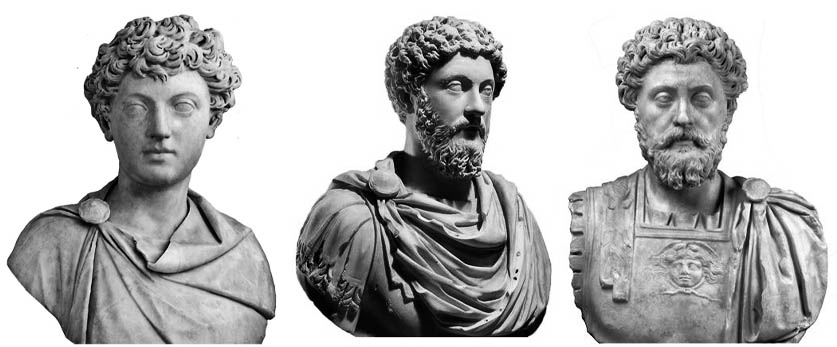
Marcus Aurelius Antoninus; Stages in Life
Marcus Aurelius Antoninus
Biographical Notes With A Special Reference To Emerging Christianity
It is often said that interpersonal relationships shape our lives for better or worse. To know and understand another person we need to know and understand his or her relationships with other people. There are no single geniuses working alone, we all work in teams and in the relationship to other people. These relationships shape personal lives. It is no different with an emperor of Rome. His relationship with his family, his friends and his enemies shaped his life and formed an unusual outlook and a particular philosophy. For this reason, we need to thoroughly examine his own history, both, as an emperor and as a person, a person who is a product of his own time. We must beware of anachronism and try to see him and understand him in the context of his own time.
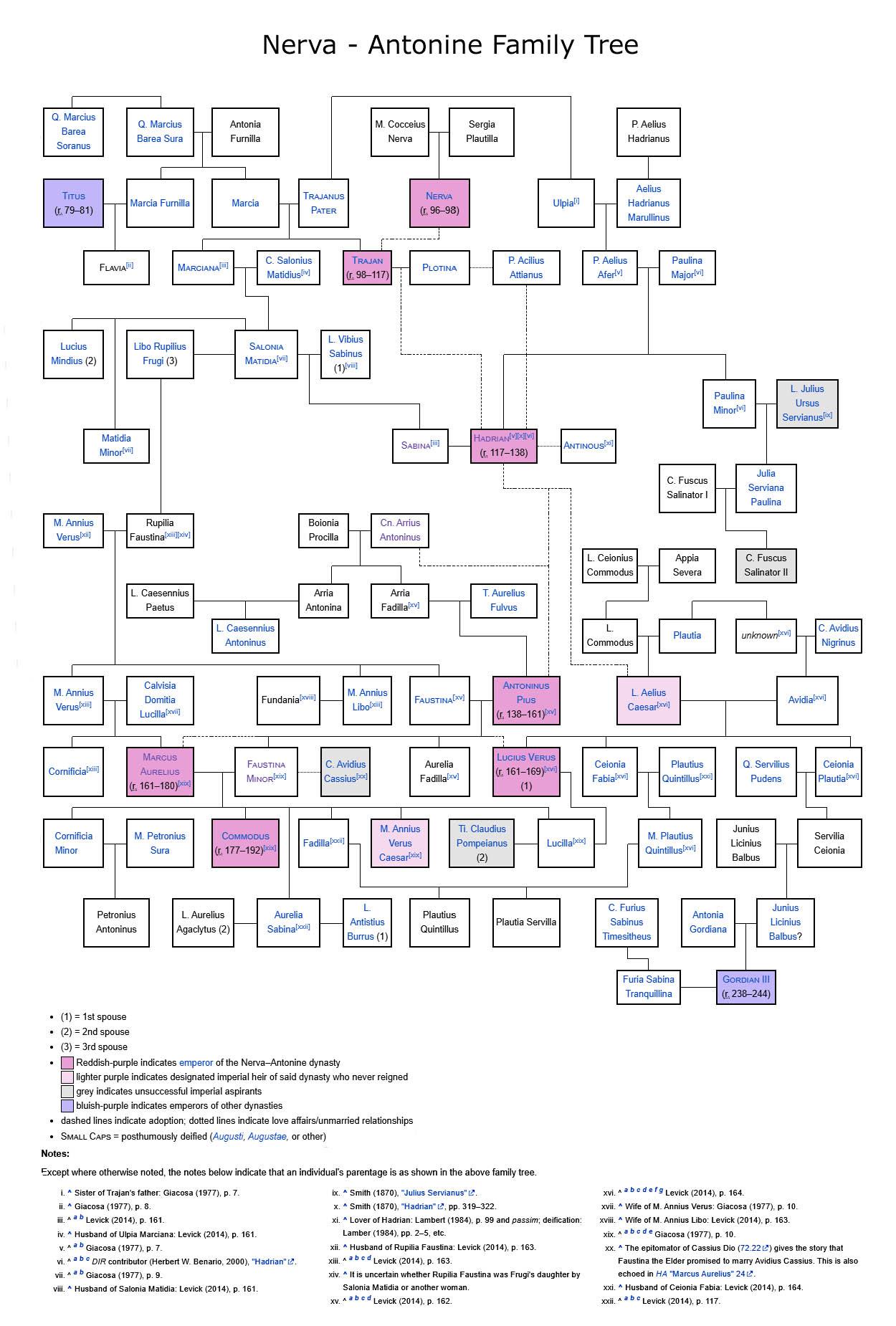
Marcus Antoninus was born in Rome on April 26, 121 CE, to Praetor Annius Verus (Note 1) and Domitia Calvilla (Note 2), also known as Lucilla. His uncle, Emperor Titus Antoninus Pius (Note 3), married Annia Galeria Faustina (4), the sister of Annius Verus, making him Marcus Antoninus's uncle.
Emperor Hadrian (5) adopted Antoninus Pius as his successor in the empire. Antoninus Pius, in turn, adopted both L. Ceionius Commodus, son of Aelius Caesar, and Marcus Antoninus, originally known as M. Annius Verus. Marcus then adopted the name M. Aelius Aurelius Verus, adding the title of Caesar in A.D. 139, incorporating "Aelius" from Hadrian's family and "Aurelius" from Antoninus Pius. Upon becoming Augustus, he discarded the name Verus and became known as Marcus Aurelius Antoninus or simply Marcus Antoninus.
Marcus Aurelius was raised with great care. He was expressing gratitude to the Gods for his upbringing, which included good grandparents, parents, sister, teachers, associates, kinsmen, and friends. He said that he was fortunate to witness the example of his uncle and adoptive father Antoninus Pius, whose virtues and wisdom he praised in his writings.
Like many young Romans, Marcus dabbled in poetry and studied rhetoric, guided by teachers such as Herodes Atticus (6) and M. Cornelius Fronto (7). The surviving correspondence between Fronto and Marcus reveals the deep affection between pupil and master, with Fronto expressing high hopes for Marcus's diligent efforts. Marcus Antoninus acknowledges Fronto's significant contribution to his education.
It is important to understand that the Romans placed great importance on history. They created some very complex web of family relationships, links and alliances.
______________
Background notes:
(1) Marcus Annius Verus (died 124 CE) was a prominent Roman politician in the 2nd century, a Praetor. His family claimed descent from Numa, second King of Rome.
(2) Calvisia Domitia Lucilla (Domitia Lucilla Minor and Domitia Calvilla, d.?155-161), was a noble Roman woman who lived in the 2nd century.
(3) Titus Aelius Hadrianus Antoninus Augustus Pius; 19 September 86 - 7 March 161), known as Antoninus Pius, was Roman emperor from 138 to 161.CE
(4) Annia Galeria Faustina the Elder, often referred to as Faustina I or Faustina Major (c. 100 - 140), was a Roman empress and wife of Antoninus Pius.
(5) Hadrian, Publius Aelius Hadrianus Augustus; 76 -138 CE was Roman emperor from 117 to 138.CE
(6) Herodes Atticus (AD 101-177),] Tiberius Claudius Atticus Herodes (suffect consul 133), was a Greco-Roman politician and sophist who served as a Roman senator. Appointed consul at Rome in 143 CE (7) Marcus Cornelius Fronto (c. 100 - late 160s), best known as Fronto, was a Roman grammarian, rhetorician, and advocate.
______________
At the age of eleven, he adopted the attire of philosophers, favouring simplicity and austerity, immersing himself in rigorous study and leading a disciplined, ascetic life, to the extent of compromising his health. Eventually, he turned away from poetry and rhetoric to embrace philosophy, aligning himself with the teachings of the Stoics. However, he did not neglect the study of law and politics, recognizing their importance in preparing him for the significant role he was destined to assume. Under the guidance of L. Volusianus Maecianus (8), a renowned jurist, he honed his legal acumen.
It is reasonable to assume that he also underwent training in Roman military tactics, an essential aspect of the education for someone who would later command troops in battles against formidable adversaries. Antoninus meticulously documented the names of his mentors and the debt of gratitude he owed to each of them in his first book. While his words may initially appear self-congratulatory, a closer examination reveals his intention to honour the virtues of his teachers and the valuable lessons he derived from them.
During his campaigns against the Quadi, as indicated by a note at the end of the first book, Antoninus likely wrote his reflections on his illustrious teachers, drawing inspiration from their teachings and contemplating their practical applications.
Among his philosophical mentors was Sextus of Chaeroneia (9), a descendant of Plutarch, whose teachings he recounted in his writings. His most esteemed instructor, however, was Q. Junius Rusticus (10), a philosopher renowned for his wisdom in both philosophical matters and public affairs. Rusticus continued to advise Antoninus even after he ascended to the imperial throne. It is rare for young leaders destined for greatness to be surrounded by such wise and influential mentors and companions. The educational journey of Marcus Antoninus stands as a remarkable example of an upbringing tailored to prepare him for the weighty responsibilities that awaited him. Gathering such a remarkable assembly of teachers, distinguished by both their knowledge and character, is unlikely to be replicated, and we have not seen a pupil comparable to him since.
Upon the death of Hadrian in July 138 CE, Antoninus Pius succeeded him. Marcus Antoninus married his cousin Faustina, Pius' daughter, around 146 CE, followed by the birth of their daughter in 147. Bestowed with the title of Caesar by his adoptive father, Marcus shared the burden of state administration with him. Their relationship was characterized by perfect friendship and trust, with Antoninus dutifully serving his father, who reciprocated with love and utmost respect.
Antoninus Pius passed away in March, year 161. Although urged by the Senate to assume sole rule, Marcus Antoninus chose to govern alongside Pius' other adopted son, L. Ceionius Commodus, commonly known as L. Verus (11). This marked the first time Rome had two emperors. Verus, however, was dissolute and unfit for his position. Despite this, Antoninus tolerated him, and Verus, it is said, showed enough wisdom to honour his brother's character and guidance. A kind and virtuous emperor and a lax co-ruler coexisted harmoniously, strengthened by Antoninus arranging for Verus to marry his daughter Lucilla.
______________
Background notes:
(8) Lucius Volusius Maecianus (c. 110 - 175) a Roman jurist, advisor the Emperor Antoninus Pius , one of teachers to Marcus Aurelius
(9) Sextus of Chaeronea circa. 160 AD was a philosopher, a grandson of Plutarch, and one of the teachers to Marcus Aurelius
(10) Quintus Junius Rusticus (c. 100 - c. 170 AD), was a Roman teacher and politician. a Stoic philosopher. He was one of the teachers of Marcus Aurelius, whom Aurelius treated with the utmost respect.
(11) Lucius Verus; Lucius Aurelius Verus Augustus; circa 130 - 169 CE)was the co-emperor of Rome with his adoptive brother Marcus Aurelius from 161 until his own death in 169.
______________
Antoninus's reign faced its first challenge with a Parthian (12) war, with Verus appointed to lead, though he contributed little to the victories achieved by Roman generals in Armenia and the regions surrounding the Euphrates and Tigris rivers. This conflict concluded in 165 CE, followed by a triumph in 166 CE. Subsequently, a plague ravaged Rome, Italy, and parts of western Europe.
The northern borders of empire were threatened by barbarian tribes beyond the Alps, reminiscent of invasions centuries prior. Antoninus spent much of his remaining years repelling these incursions, particularly against the Marcomanni(13) and Quadi (14). Verus's sudden death in 169 CE left Marcus Antoninus as the sole ruler.
During the Germanic wars, Antoninus resided for three years on the Danube at Carnuntum (15). He successfully expelled the Marcomanni from Pannonia and decisively defeated the Quadi in 174 CE.
In the year 175 CE, Avidius Cassius (16), a capable Roman commander in Asia, revolted and proclaimed himself Augustus. However, his rebellion was short-lived as he was assassinated by his own officers. Antoninus displayed clemency towards Cassius's family and supporters, as evidenced by his letter to the Senate advocating mercy for the accused.
Upon learning of Cassius' rebellion, Antoninus embarked for the East. Although he seems to have briefly returned to Rome in year 174, he soon resumed the campaign against the Germanic people. It is likely that he proceeded directly to the East from the Germanic conflict. His wife Faustina, who accompanied him to Asia, tragically passed away suddenly at the foot of the Taurus Mountains, causing immense sorrow to her husband.
Historian Capitolinus (17), who wrote the biography of Antoninus, along with Dion Cassius, accused the empress of disgraceful betrayal and vile immorality towards her husband. Capitolinus asserts that Antoninus was either unaware of or pretended to be ignorant of the rumours. Such malicious gossip has been prevalent throughout history, particularly in the annals of imperial Rome. Antoninus cherished his wife, describing her as "obedient, affectionate, and simple." Similar scandalous tales had surrounded Faustina's mother, the wife of Antoninus Pius, yet he too held his wife in highest regard. Antoninus Pius, in a letter to Fronto following his wife's passing, expressed a preference for exile with her over residing in the Roman palace without her. Few men would offer their wives a better reputation than these two emperors. Capitolinus wrote during Diocletian's (18) era, intending perhaps to convey truth, yet he proves to be a weak biographer. Dion Cassius, a notably critical historian, habitually disseminated-and likely believe-any scandal against individuals. Thus,their account looks quite unreliable. It is curious that even today in 21st century historians cherry-pick evidence in the writing of such historians ready to believe the unreliable and willfully ignore other reliable evidence.
______________
Background notes:
(12) The Parthian Empire (247 BCE - 224 CE), AKA the Arsacid Empire was a major power in ancient Iran. (13) The Marcomanni were a group of early Germanic peoples developing a powerful kingdom north of the Danube. Tacitus and Strabo identified them as Suebian. (14) The Quadi were an early Germanic people, see related Marcomanni. (15) Carnuntum, a Roman legionary fortress (castrum legionarium) and headquarters of the Pannonian 50 CE. (Lower Austria) (16) Gaius Avidius Cassius (c. 130 -175 CE) Roman general and would be usurper. He was son of Gaius Avidius Heliodorus, governor of Roman Egypt (17) Lucius Cassius Dio (c.165 - c.235), also known as Dio Cassius was a Roman historian and senator. Capitolinus, also known as Aelius Spartianus, was a Roman historian and biographer who lived around the late 2nd & early 3rd centuries CE. 18 Diocletian (Gaius Aurelius Valerius Diocletianus Augustus; 22 December 244 - 3 December 311), was a Roman emperor from 284 to 305 CE
______________
Antoninus continued his journey to Syria and Egypt, and during his return to Italy via Athens, he underwent initiation into the Eleusinian Mysteries (19). The emperor adhered to established rituals and religious ceremonies with due reverence,yet this does not necessarily denote superstition, as his writings attest. This exemplifies that a ruler's public actions do not always mirror their personal beliefs. A wise leader avoids direct opposition to prevailing superstitions among their populace, understanding that offense does not enlighten their prejudices. The Romans tolerated local religions and social structures in their provinces and in Rome.
Antoninus and his son Commodus celebrated a triumphant entry into Rome, possibly in celebration of German victories, on December 23, 176 CE. The subsequent year saw Commodus join his father in ruling the empire, adopting the title of Augustus. This period, 177 CE,holds significance in ecclesiastical history. Attalus and others faced execution in Lyon (20) for their adherence to Christianity, as evidenced by a letter preserved by Eusebius (21). The missive from the Christians of Vienna and Lyon details the torture inflicted on believers, including Attalus, who, despite suffering grievously, exhibited remarkable endurance. Such accounts, while remarkable, often go unnoticed by modern historians of ecclesiastical affairs.
The letter serves as a singular piece of evidence. Whoever wrote it in the name of the Gallic Christians provides our sole testimony regarding both the commonplace and extraordinary aspects of the narrative. It is imperative to consider the entirety of the writer's account; cherry-picking elements that suit our beliefs while disregarding others is a flawed approach. Some modern scholars employ this tactic, selectively embracing portions of a narrative and suppressing the rest, which is academically dishonest. One must either fully accept or reject the letter's contents, and neither decision warrants blame. However, those who choose to dismiss it, may still acknowledge the possibility or some similarity of it in real events. Yet, if they presume the writer to have fabricated certain details, discerning the truth becomes challenging. Meanwhile, the conflict on the northern frontier persisted unabated during Antoninus's Eastern sojourn, prompting the emperor to depart from Rome, once again, to confront the threat. In the year 179 CE, the Germanic intruders suffered a decisive defeat in a significant battle. During this military campaign, the emperor fell victim to a contagious illness and passed away either in the camp at Sirmium (22), in Lower Pannonia, or in Vindebona (Vienna) on March 17, 180 CE, at the age of fifty-eight. His son Commodus was by his side. The emperor's remains, or possibly his ashes, were transported to Rome, where he was posthumously deified. Many who could afford it honoured him with statues or busts, and even at the time Capitolinus wrote, numerous households retained statues of Antoninus among their household deities, essentially sanctifying him. Commodus, in remembrance of his father, commissioned the Antonine column, now located in the Piazza Colonna in Rome. The column's spiral reliefs depict Antoninus's triumphs over the Marcomanni and the Quadi, including the purported miraculous rain that refreshed Roman troops and confounded their adversaries. While the statue of Antoninus once adorned the column's capital, it was later replaced with a bronze statue of St. Paul by Pope Sixtus V at an unknown time.
______________
Background notes:
(19) The Eleusinian Mysteries were initiations held every year for the cult of Demeter and Persephone based at Eleusis in ancient Greece. (20) The persecution in Lyon in the year 177 CE of Christians in Lugdunum, Roman Gaul (present-day Lyon, France). An account of this persecution is described in a letter preserved in Eusebius's Ecclesiastical History, book 5, chapter 1. Gregory of Tours describes the persecution in De Gloria martyrum. (21) Eusebius of Caesarea (circa 260 - 340 CE), also known as Eusebius Pamphili as a historian of Christianity, exegete, and Christian polemicist. He became the bishop of Caesarea Maritima about 314 CE. (22) Sirmium, a city in the Roman Pannonia, located on the Sava River, on the site of modern Sremska Mitrovica in northern Serbia. First mentioned in the 4th century BCE
______________
Historical evidence from the era of Antoninus is notably lacking, with some surviving accounts deemed incredulous. Among these is the tale of a miracle during the year 174 wars with the Quadi, where the Roman army faced perilous thirst until a sudden storm delivered rain upon them while unleashing fire and hail upon their enemies, leading to a significant victory. Both non-Christian and Christian sources attribute this event differently. While Christians claim it because of the prayers of a Christian legion within the emperor's army, non-Christian accounts credit their own gods. However, the title "Thundering" given to this legion by Antoninus supposedly in acknowledgment of the miracle is contested. Dion Cassius mentions the legion's name long before Antoninus's reign, suggesting the name predates the supposed event. Eusebius cites Apolinarius (23), bishop of Hierapolis, as a source for the legion's renaming, but this assertion lacks corroborating evidence. Additionally, Valesius (24) argues that the legion's name likely refers to its place of duty rather than its origin, casting doubt on the Christian attribution of the miracle. Despite differing interpretations, the incident remains a subject of historical debate and scrutiny.
It was suggested that the emperor submitted a report of his victory to the Senate, a customary practice of the time. However, the contents of this letter remain unknown as the letter is not extant. Dacier (25) suggests that the emperor's letter might have been deliberately destroyed by either the Senate or adversaries of Christianity to prevent the perpetuation of such an honourable testimony to Christians and their faith. Ironically, Dacier overlooks the contradiction in his argument when he proceeds to discuss the alleged contents of the letter, acknowledging its destruction. Even Eusebius, a noted historian, could not find it.
Nevertheless, there does exist a Greek letter purportedly from Antoninus addressed to the Roman populace and the Senate following the significant victory. Sometimes appended to Justin's first Apology, this letter has no connection to the Apology. Regrettably, it stands as one of numerous crude forgeries. Even if authentic, it diverges significantly from Antoninus's actual report to the Senate. In this spurious letter, the emperor supposedly absolves himself of charges of persecuting Christians, asserting that if an individual is accused solely on grounds of being a Christian and confesses, with no additional evidence against that individual, he or she must be released. However, this fraudulently fabricated decree includes a grotesque clause, purportedly inserted by an incredibly uninformed individual, mandating that the accuser be burned alive. (see Box A1)
******************************
EXPLANATORY BOX A 1:
Eusebius (26) (v. 5) cites Tertullian's (27) Apology to the Roman Senate in corroboration of report. According to Eusebius, Tertullian mentions that there were existing letters from the emperor wherein he acknowledges that his army was saved by the prayers of Christians, and he even "threatened to punish with death those who dared to accuse us." It is conceivable that the currently extant forged letter might be one of those referenced by Tertullian, as he speaks in the plural, "letters." Much discussion has ensued regarding this purported miracle of the Thundering Legion, yet much of it is deemed of little value. A dissertation on this alleged miracle can be found in Moyle's Works, London, 1726.
(23) Bishop of Hierapolis in Phrygia well known for treatises against the heretics. (24) Henri Valois (circa 1603-76) or in classical circles, Henricus Valesius, was a philologist and a student of classical and ecclesiastical historians.
(25) Anne Le Fèvre Dacier (c. 1651 - 17 August 1720), better known during her lifetime as Madame Dacier, was a French scholar, translator, commentator and editor of the classics, including the Iliad and the Odyssey
(26)Eusebius of Caesarea (C. 260 - 340 CE), also known as Eusebius Pamphili as a historian of Christianity, exegete, and Christian polemicist. He became the bishop of Caesarea Maritima about 314 CE.
(27) Tertullian (Quintus Septimius Florens Tertullianus; c. 155 - c. 220 AD) was an early Christian author
******************************
During the reigns of Antoninus Pius and Marcus Antoninus, significant literary works emerged within the Christian community. Justinus (28) presented the first Apology during this period, while Tatian (29) delivered a fierce critique of established religions in his Oration against the Greeks under Marcus Antoninus's rule. Additionally, Athenagoras (30) addressed Marcus Antoninus on behalf of Christians, as did Melito (31), Bishop of Sardes, and Apolinarius (32).
Justinus's first Apology was directed towards T. Antoninus Pius and his two adopted sons, Marcus Antoninus and L. Verus, although it remains uncertain whether they read it. The Second Apology, despite being labelled "to the Roman Senate," was likely mis-attributed by a copyist. Justinus addresses Romans in its first chapter and refers to events during the time of Marcus Antoninus and L. Verus, directly appealing to the emperor in certain passages.
Eusebius indicates that the Second Apology was directed to Antoninus Verus, referring to Marcus Antoninus. In this text, Justinus or the author laments the persecution of those, even Stoics, who adhered to ethical reason,citing examples like Musonius (33). Justinus himself faced martyrdom in Rome for refusing to sacrifice to the gods, likely occurring during Marcus Antoninus and L. Verus's rule, as evidenced by Rusticus serving as the city's praefect. Accounts from the Martyrium (34) detail Rusticus's (35) interrogation of the accused, all of whom professed Christianity. When asked if he anticipated heavenly ascent and reward despite facing death, Justinus confidently affirmed his certainty in such an outcome.
EXPLANATORY BOX B 1:
See the Martyrium Sanctorum Justini, &c., in the works of Justinus, ed. Otto, vol. ii. 559. "Junius Rusticus Praefectus Urbi erat sub imperatoribus M. Aurelio et L. Vero, id quod liquet ex Themistii Orat. xxxiv Dindorf. p. 451, et ex quodam illorum rescripto, Dig. 49. 1. I, Sec. 2" (Otto). The rescript contains the words: "Junium Rusticum amicum nostrum Praefectum Urbi." The Martyrium of Justinus and others is written in Greek. It begins: "In the time of the wicked defenders of idolatry impious edicts were published against the pious Christians both in cities and country places, for the purpose of compelling them to make offerings to vain idols. Accordingly, the holy men (Justinus, Chariton, a woman Charito, Paeon, Liberianus, and others) were brought before Rusticus, the Praefect of Rome."
(28) Justinus; The First Apology was an early work of Christian apologetics addressed by Justin Martyr to the Roman Emperor Antoninus Pius. Justin also provides the emperor with a defence of the philosophy of Christianity.
(29) Tatian of Adiabene, or Tatian the Syrian c. 120 - c. 180 AD) was Christian theologian of the 2nd century.
(30) Athenagoras was an Athenian, a philosopher, and a convert to Christianity, an Ante-Nicene Christian apologist in 2nd century of whom not much is known (31) Melito describes Christianity as a philosophy originated among the barbarians, but widely practiced under the Roman Empire. Melito asks the emperor to rethink the accusations against the Christians and to renounce the edict against them.
(32) Apollinaris the Younger, also known as Apollinaris of Laodicea and Apollinarius (circa 330 - 382), was a bishop of Laodicea in Syria, theologian.
(33) Gaius Musonius Rufus was Roman Stoic philosopher in the 1st Century CE
(34) A martyrium, sometimes anglicized martyry, is a church or shrine built over the tomb of a Christian martyr.
(35) Quintus Junius Rusticus (c. 100 - c. 170 AD), was a Roman teacher and politician, Suffect Consul and later Praefect of Rome. He was a Stoic philosopher and was one of the teachers of the Marcus Aurelius.
******************************
Ultimately, the prisoners faced a test of obedience: they were instructed to make sacrifices to the gods. None complied, and Rusticus, the authority presiding over them, decreed that those who defied the order to sacrifice and honour the emperor should face the punishment prescribed by law-whipping followed by beheading. The martyrs were then led to the customary execution site and beheaded, their bodies clandestinely moved and interred by faithful followers.
The persecution endured by Polycarp (36) in Smyrna (37) occurred during the reign of Marcus Aurelius. The primary account of these events comes from a letter written by the church of Smyrna to other Christian congregations, preserved by Eusebius. However, scholars differ on the precise timing of Polycarp's death, with estimates varying by as much as twelve years. Accounts of Polycarp's martyrdom recount miraculous occurrences, some of which were not included in Eusebius's version but were present in an ancient Latin rendition published by Usher. This version is thought to have been created shortly after Eusebius's time. The letter's conclusion attributes its transcription to Caius, who copied it from Irenaeus (38), a disciple of Polycarp, with subsequent copies made by Socrates and Pionius, the latter claiming guidance from Polycarp's revelation. Some modern historians choose to omit these embellished miraculous details from their retellings of Polycarp's martyrdom (39).
Understanding the plight of Christians during Marcus Aurelius's reign necessitates revisiting Trajan's (40) era. During Pliny the Younger's governorship of Bithynia, Christians were numerous and adherents to traditional religions were dwindling. Temples stood deserted, festivals were abandoned, and there were no buyers for sacrificial animals. Those vested in maintaining the old faith saw their livelihoods threatened. Pliny found himself perplexed by the Christians brought before him-unable to prove any crimes, he deemed their adherence to Christianity punishable solely due to their steadfastness. In a letter to Trajan, Pliny characterized Christianity as a debased and outlandish superstition, suggesting it could be curbed if believers were given the chance to renounce it.
He sought guidance from the emperor, as he was unsure of the appropriate course of action. He noted that he had never been involved in legal investigations concerning Christians, and therefore, he was uncertain about what to question, or to what extent to probe and penalize. This indicates that it was not a novel concept to scrutinize a person's adherence to Christianity and to punish them for it (41).
Trajan's rescript still exists. He endorsed the governor's decision on the matter, but he stated that no proactive search should be conducted for Christians; if a person was accused of following the new religion and found guilty, they should not be penalized if they declared that they were not a Christian, and substantiated their denial by demonstrating their respect for the Roman gods. He further added that anonymous accusations should be disregarded, as they set a poor precedent. Trajan was a kind and rational man; both compassion and strategy likely influenced him to pay as little attention to the Christians as possible, allowing them to live in peace, if feasible. Trajan's rescript is the first known legislative act by the leader of the Roman state concerning Christianity. It does not seem that Christians faced further disruption during his reign. The execution of Ignatius (42) by Trajan's order is not universally accepted as a historical event.
******************************
EXPLANATORY NOTES:
(36) Polycarp, CE 69 - 155) was a 2nd-century Christian bishop of Smyrna. According to the Martyrdom of Polycarp, he died a martyr, bound and burned at the stake. Legend has it that fire failed to consume his body.
(37) Smyrna was a Greek city located at a strategic point on the Aegean coast of Anatolia.
(38) Caius was a Roman priest who lived during the 2nd century AD. Irenaeus, circa 130-140 AD in Asia Minor (possibly Smyrna), heard St. Polycarp preach during his youth. Both Caius and Irenaeus played crucial roles in defending their faith
(39) Conyers Middleton, An Inquiry into the Miraculous Powers, &c. p. 126. Middleton says that Eusebius omitted to mention the dove, which flew out of Polycarp's body, and Dodwell and Archbishop Wake have done the same. Wake says, "I am so little a friend to such miracles that I thought it better with Eusebius to omit that circumstance than to mention it from Bp. Usher's Manuscript," which manuscript, however, says Middleton, he afterwards declares to be so well attested that we need not any further assurance of the truth of it.
(40) Trajan, circa 53 - 117 CE) was Roman emperor from 98 to 117. Officially declared by the Senate Optimus Princeps ("best ruler").
(41) Orosius speaks of Trajan's persecution of the Christians, and of Pliny's application to him having led the emperor to mitigate his severity. The punishment by the Mosaic law for those who attempted to seduce the Jews to follow new gods was death. If a man was secretly enticed to such new worship, he must kill the seducer, even if the seducer were brother, son, daughter, wife, or friend. (Deut. xiii.)
(42) The Martyrium Ignatii, first published in Latin by Archbishop Usher, is the main evidence for the circumstances of Ignatius' death.
******************************
During Hadrian's era, Roman government could no longer ignore the significant growth of Christianity and the widespread animosity towards them. If provincial governors were inclined to leave them be, they could not withstand the zealotry of the other populace, who perceived Christians as atheists. The Jews, who were dispersed throughout the Roman Empire, were as antagonistic towards Christians
A rescript of Hadrian to Minucius Fundanus, the Proconsul of Asia, which is included at the end of Justin's first Apology (45), advises the governor that innocent individuals should not be harassed, and false accusers should not be permitted to blackmail them; accusations against Christians must be formally made, and public outcries should be ignored; when Christians were duly prosecuted and found guilty of unlawful acts, they should be punished according to their crimes; and false accusers should also face punishment. Antoninus Pius is reported to have issued similar rescripts. Hadrian's rescript appears to be very favourable to Christians; but if we interpret it to mean that they were only to be punished like others for unlawful acts, it would be meaningless, as this could have been done without seeking the emperor's counsel. The true intent of the rescript is that Christians should be penalized if they persisted in their faith, and did not demonstrate their renunciation of it by acknowledging the Roman religion. This was Trajan's policy, and we have no grounds to believe that Hadrian extended more concessions to Christians than Trajan did.
A rescript of Antoninus Pius to the Commune of (Greek: to koinon tes Asias) is also included at the end of Justin's first Apology and is referenced in Eusebius (E.H. iv. 13). The rescript is dated to the third consulship of Antoninus Pius. (See Box below)
******************************
EXPLANATORY BOX :
Eusebius (E.H. iv. 12), after presenting the initial part of Justinus' first Apology, which includes the address to T. Antoninus Pius and his two adopted sons, adds: "The same emperor being addressed by other brethren in Asia, honoured the Commune of Asia with the following rescript." This rescript, found in the following chapter of Eusebius (E.H. iv. 13), bears solely the name of Caesar Marcus Aurelius Antoninus Augustus Armenius, despite Eusebius having previously stated that he was about to present a rescript of Antoninus Pius. There are notable discrepancies between the two versions of the rescript, in addition to the difference in the title, which makes it unclear whether the forger intended to attribute this rescript to Antoninus Pius or to M. Antoninus. The author of the Alexandrine Chronicum states that Marcus, influenced by the pleas of Melito46 and other church leaders, wrote an Epistle to the Commune of Asia, in which he prohibited the persecution of Christians due to their faith. Valesius believes this to be the letter or rescript found in Eusebius (iv. 13), and to be the response to Melito's Apology. However, it is certain that Marcus did not author this letter found in Eusebius, and it remains unknown what response he gave to Melito. The rescript asserts that the Christians - they are the intended subjects, even though the term "Christians" is not explicitly mentioned in the rescript - should not be harassed unless they were conspiring against Roman authority; and no individual was to be penalized merely for being a Christian. However, this rescript is deemed fraudulent. Anyone with a moderate understanding of Roman history would recognize from its style and content that it is a poorly executed forgery.
(43) There is evidence of Justinus (ad Diognetum, c. 5) to this effect: "The Christians are attacked by the Jews as if they were men of a different race, and are persecuted by the Greeks; and those who hate them cannot give the reason of their enmity."
(44) Christian Apologetics is the branch of Christian theology that defends and attempts to provide a reasonable and rational explanations for the truth of the Christian faith.
(45) And in Eusebius (E.H. iv. 8, 9). Orosius (vii. 13) says that Hadrian sent this rescript to Minucius Fundanus, proconsul of Asia after being instructed in books written on the Christian religion by Quadratus, a disciple of the Apostles, and Aristides, an Athenian, an honest and wise man, and Serenus Granius. In the Greek text of Hadrian's rescript there is mentioned Serenius Granianus, the predecessor of Minucius Fundanus in the Government of _Asia_. This rescript of Hadrian has clearly been added to the Apology by some later editor.
******************************
During the era of M. Antoninus the conflict between the old established and new beliefs intensified and the followers of other religions implored those in power to mount a more systematic resistance to the encroachments of the Christian faith. In his Apology to M. Antoninus, Melito portrays the Christians of Asia as being persecuted under new imperial edicts. Unscrupulous informers, he states, individuals covetous of others' property, exploited these edicts as a means to plunder those who were causing no harm. He questions whether a just emperor could have issued such an unjust command; and if the most recent order did not originate from the emperor, the Christians plead with him not to abandon them to their adversaries. (see Box below)
From this, we deduce that there were at least some imperial rescripts or constitutions of M. Antoninus that served as the basis for these persecutions. Being a Christian was now a punishable offence, unless the accused renounced their faith. This was followed by the persecutions in Smyrna, which some critics date to year 167 CE, a decade prior to the persecution of Lyon. The provincial governors under M. Antoninus might have found sufficient justification in Trajan's rescript to penalize Christians, and the zealotry of the non-Christian populace would incite them to persecution, even if they were reluctant.
But in addition to the Christians' rejection of all non-Christian ceremonies, we must remember that they unequivocally asserted that all non-Christian religions were false. The Christians, therefore, declared war against the non-Christian rituals, and it is worth noting that this was a declaration of enmity against the Roman government, which tolerated all the various forms of religion and churches that existed in the empire, and could not logically tolerate another religion which proclaimed that all the others were false and that all the grand ceremonies of the empire were merely idolatry and devil worship.
If an accurate ecclesiastical history existed, we would have a clearer understanding of how the Roman emperors sought to suppress the emerging religion. We would learn about their efforts to punish Christians solely for their faith, as Justin attests in his Apology. It is likely to be true that Justin believes honestly all the claims in his Apology to be the truth on this matter.
******************************
EXPLANATORY BOX :
This passage is referenced in Eusebius, iv. 26, and Routh's Reliquiae Sacrae, vol. I, along with accompanying notes. Deciphering this fragment presents challenges. Mosheim misinterpreted one section, mistakenly suggesting that Marcus offered rewards for denouncing Christians, a claim entirely unfounded. Melito describes the Christian religion as "our philosophy," originating among the Jews (whom he refers to as barbarians) and flourishing under Roman rule during the time of Augustus, contributing to the empire's prosperity; suggesting that from that time the power of Roman Empire grew great and glorious. He asserts that if the emperor protects this "philosophy", which emerged and developed alongside the empire during Augustus's reign, (thus, Melito suggested) emperor will garner favour and support from the people. Melito contends that the Christian religion experienced no harm during the reign of Augustus but rather enjoyed respect and honour ("that any man could desire"). He attributes the origin of the persecution of Christians to Nero and Domitian. This was driven by malicious slander perpetrated by some devious men hoping to profit through these prosecutions. However, he credits preceding emperors, particularly Antoninus Pius, for rectifying these false accusations and protecting Christians through official rescripts. Melito references correspondence from Hadrian and Antoninus Pius, emphasizing their instructions to provincial governors and to the people of Larissa, Thessalonica, and others not to trouble Christians. Melito wrote thus: "We are persuaded that thou who hast about these things the same mind that they had, nay rather one much more humane and philosophical, wilt do all that we ask thee."- He concludes by expressing confidence that the recipient of the letter will act favourably towards Christians. This Apology was likely written after year 169, referencing only Marcus and his son Commodus, following Verus's death. Melito's testimony suggests that Christians faced persecution only under Nero and Domitian, with renewed persecution initiated by Marcus Antoninus based on misused orders. Melito claims "that the race of the godly is now persecuted and harassed by fresh imperial orders in Asia, a thing which had never happened before." His assertion is not true for it is well documented that Christians had been prosecuted in Trajan's time and on many occasions by provincial governors acting alone.
******************************
And again, if an accurate ecclesiastical history existed, we would also uncover the extent of public outcry and riots surrounding this issue, as well as the role played by zealous, uninformed and ignorant Christians, for they were numerous, in fuelling the conflict between the Roman government and their nascent religion.
Existing ecclesiastical histories are evidently distorted and falsified, containing exaggerated accounts. However, it is indisputable that during the reign of Marcus Antoninus, non-Christian populations openly opposed Christians, resulting in executions solely based on their faith.
Eusebius notes a surge in persecution during the seventeenth year of Antoninus' rule were primarily driven by urban mobs. WhileEusebius tends to exaggerate, his mention of widespread martyrdomacross the world suggests the severity of the situation. Eusebius highlights Gaul as a notable example of persecutions, also citing the letters from the churches of Vienna and Lugdunum. It is plausible that the Christians' fanaticism fuelled these persecutions, causing significant challenges for both local governors and the emperor. The extent of Marcus Antoninus' involvement in these prosecutions remains unclear due to sparse historical records of his reign.
It is worth noting that Marcus Antoninus did not institute the policy against Christians; that was done by Trajan. While it is conceivable that Marcus may have been inclined to leave Christians undisturbed, it cannot be asserted with certainty that he had the authority to do so. It would be erroneous to assume that Antoninus wielded absolute power. His authority was bounded by constitutional constraints, the Senate's influence,and the established customs of his predecessors and numerous precedents. It cannot be asserted that he actively persecuted others (47), as there is no concrete evidence to support such a claim, though it is evident that he harboured unfavourable views towards Christians, as indicated by his own statements. However, his knowledge of them was likely limited to their opposition to the Roman religion, leading him to perceive them as a threat to the state, regardless of the sincerity or insincerity of certain Apologists. It is important to acknowledge these points to present a fair assessment of a man whom both his contemporaries and future generations revered for his virtue, kindness and compassion.
******************************While acknowledging the authenticity of certain documents would absolve him entirely of any involvement in persecutions, our commitment to truth leads us to reject their genuineness, leaving him accountable for whatever blame is rightfully his (48). Furthermore, it is evident that Antoninus did not derive his ethical principles from a religion with which he had no familiarity (49).
EXPLANATORY BOX :
47 Except that of Orosius (vii. 15), who writes that during the Parthian war there were persecutions in Asia and Gallia by the orders of Marcus (praecepto ejus), and "many were crowned with the martyrdom of saints."
******************************
The Emperor's Reflections, commonly known as his Meditations, undoubtedly represent genuine work. In the first book, he discusses his personal life, family, and mentors, while subsequent books feature mentions of himself. Suidas (50) mentions a work by Antoninus in twelve books, referred to as the "conduct of his own life," but the precise title remains unknown. Xylander (51), the first editor of this work, utilized a manuscript containing all twelve books, although its current whereabouts are uncertain. Another complete manuscript exists in the Vatican library, lacking titles for the individual books except for the eleventh, which bears the inscription "(Greek: Markou autokratoros)."
It is evident that the emperor recorded his thoughts and reflections as they occurred to him, likely with the intention of personal use. It is conceivable that he left behind a complete manuscript, possibly written in his own hand, as it seems unlikely that such a diligent individual would entrust the transcription of his most intimate thoughts to another person. Additionally, we can speculate that it is possible that he intended the book for his son Commodus, despite the latter's lack of interest in his father's philosophy. Nevertheless, the existence of this valuable volume was preserved by careful hands, as referenced by other later writers in addition to Suidas.
Many classical scholars have devoted significant effort to studying the text of Antoninus. The most thorough edition was crafted by Thomas Gataker (52) in 1652, presented in a folio format. Gataker's second edition, supervised by George Stanhope in 1697, also in folio, further refined the work. A subsequent edition was released in 1704. Gataker not only suggested numerous beneficial corrections but also offered a new Latin rendition, although it was said not to be of the highest calibre in terms of Latin prose. However, it generally encapsulated the spirit of the original text and always outperforms some of the more modern translations in terms of linguistic accuracy. He enriched the text with marginal references to corresponding passages and wrote a commentary, one of the most comprehensive ever written on an ancient author. We put more credence on the work of a translator and an author who is well versed in and current in Latin and Greek languages.
This commentary encompasses the editor's clarification of complex passages and quotations from a broad spectrum of Greek and Roman authors to shed light on the text. It serves as an extraordinary testament to scholarship and diligence, unparalleled by any English scholar to date.
******************************
EXPLANATORY BOX :
(48) Dr. F.C. Baur, work entitled "Das Christenthum und die Christliche Kirche der drei ersten Jahrhunderte," &c., has examined this question. (49) In the Digest, 48, 19, 30, there is the following excerpt from Modestinus: "Si quis aliquid fecerit, quo leves hominum animi superstitione numinis terrerentur, divus Marcus hujusmodi homines in insulam relegari rescripsit."
(50) Suidas (Souidas, Soudas), author of, perhaps, the most important Greek lexicon or encyclopedia. Nothing is known of Suidas himself except that he lived about the middle of the tenth century, at Constantinople, he was probably an ecclesiastical person.
(51) Wilhelm Xylander (born Wilhelm Holtzman, graecized to Xylander; 1532 -1576) was a German classical scholar and humanist. He served as rector of Heidelberg University in 1564
(52) Thomas Gataker (1574 -1654) was an English clergyman, theologian and translator
Also refer to Book 9, Section 3. The emperor likely refers to fanatics such as those mentioned by Clemens (as cited by Gataker53 in this context). Rational Christians did not associate with these individuals. Clements writes thus: "Some of these heretics, show their impiety and cowardice by loving their lives, saying that the knowledge of the really existing God is true testimony (martyrdom), but that a man is a self-murderer who bears witness by his death. We also blame those who rush to death; for there are some, not of us, but only bearing the same name, who give themselves up. We say of them that they die without being martyrs, even if they are publicly punished; and they give themselves up to a death which avails nothing, as the Indian Gymnosophists give themselves up foolishly to fire" Cave (54), in his work 'Primitive Christianity' (Chapter 7, Volume II), speaks of Christians: "They did flock to the place of torment faster than droves of beasts that are driven to the shambles (55). They even longed to be in the arms of suffering. Ignatius, though then in his journey to Rome in order to his execution, yet, by the way, as he went could not but vent his passionate desire of it 'Oh that I might come to those wild beasts that are prepared for me; I heartily wish that I may presently meet with them; I would invite and encourage them speedily to devour me, and not be afraid to set upon me as they have been to others; nay, should they refuse it, I would even force them to it;'" … and more along these lines from Eusebius. Cave, a sincere and virtuous man, praises the Christians for this; however, it is suggested that he misunderstood the situation. Admirable as they may be, as individuals who adhere to their principles even unto death; but these fanatical Christians are like Gymnosophists whom Clemens dismisses with contempt.
~~~ Gymnosophists, or "naked philosophers" or "naked wise men", is a term coined by the Greeks to describe certain ancient Indian philosophers. These philosophers practiced asceticism to such an extent that they considered food and clothing as obstacles to clear thinking. They were known to be vegetarians, as noted by several Greek authors.
******************************
In the preface,Gataker discloses that he composed it in Rotherhithe, near London, during a severe winter when he was seventy-eight years old in 1651, a period when luminaries such as Milton, Selden, and other notable figures of the Commonwealth era were alive, as well as the esteemed French scholar Saumaise (Salmasius)(56), who corresponded with Gataker and aided him in his edition of Antoninus. The Greek text has also been edited by J.M. Schultz in Leipzig in 1802, and by the learned Greek scholar Adamantinus Corais in Paris in 1816. Schultz's text was republished by Tauchnitz in 1821. Translations of Marcus Aurelius Antoninus are available in English, German, French, Italian, and Spanish, among potentially others. Other English translations, one by Jeremy Collier in 1702, is notable for its crude and vulgar interpretation of the original. The French translation by Alexis Pierron, included in the Charpentier collection, exceeds Dacier's version, which was honoured with an Italian translation in Udine in 1772. It must be said that we were not too keen on modern translators for I felt that their adaptations, trying to accommodate "modern" reader, lost their linguistic integrity.
An Italian translation of the book, dating back to 1675, exists. It was translated by Cardinal Francis Barberini (57) (the elder), nephew of Pope Urban VIII. He spent the twilight years of his life translating the Roman emperor's thoughts into Italian, aiming to spread seeds of wisdom among the believers. He dedicatedthis translation tohis soul, hoping,in his own powerful words,to make it "redder than his purple" upon witnessing the virtues of this "Gentile "(Pierron, Preface).
******************************
EXPLANATORY BOX :
(53) Thomas Gataker (1574 -1654) was an English clergyman, theologian and translator.
(54) William Cave (1637 - 1713) was an English divinity scholar. The merits of Cave as a historian and writer are in the thoroughness of his research.
(55) Archaic term for a slaughterhouse, or a place of mass slaughter or bloodshed.
(56) Claudius Salmasius, also known as Saumaise, was a French classical scholar. Born as Claude Saumaise in 1588, He known for his literary criticism and his works on ancient languages.
(57) Francesco Barberini (1597 - 1679) was an Italian Catholic Cardinal
******************************
I favoured George Long's (58) and Frances Hutchenson's (59) translations for their academic merit. Francis Hutcheson's translation 1742 is highly regarded for its depth, clarity and scholarly approach. George Long's translation 1862 is often appreciated for its unique perspective, especially considering it reflects the linguistic accuracy, historical perspective and cultural sensibilities. Both translations were based largely on Gataker's.
Translation of this book by George Long is based on the Greek version however in the process comparisons were made with other translations. I undertook writing parts of this book for my personal use as an intellectual challenge of placing old ideas and ancient writings into new environment and new era. However, it might also be beneficial to others, prompting me to decide to publish it on the web site. Often understanding the original thoughts from different times is a challenge and translating them into the new world is even more difficult. Dealing with ancient thoughts and anachronism makes errors possible and inevitable. However, I have compared several translations and I feel that I have seldom misinterpreted the meaning by using Long's translation considering it to be the most reliable. Those who wish to compare this work with other versions and various commentaries should not hastily suspect that I am incorrect. Some passages convey the meaning even if it does not become obvious at the first glance. The essay on Marcus Antoninus' philosophy, in particular, reflects my understanding of philosophy and the difficulties anachronism imbues.
When interpretation or translation of some passages differs markedly from others, I followed the guidance from George Long (60) and Francis Hutcheson (61) and believe other interpretations are incorrect in those passages. I have identified and marked some of them indicating textual corruption or significant uncertainty in the meaning. I could have opted for a more fluid and accessible language (such as in translations by Robin Hard (62), but I feel that more archaic and rougher style better reflects the character of the original. Sometimes, the obscurity in the translation accurately mirrors the ambiguity of the Greek text as it is used in the translations of George Long.
The last echo of Stoic philosophy is noticed in Simplicius' (63) Commentary on Epictetus' Enchiridion. Simplicius was not a Christian, and it is unlikely that such a man would convert during a time when Christianity was heavily tainted. However, he was genuinely religious or spiritual and concluded his commentary with a prayer to the Deity that no Christian could enhance. From Zeno to Simplicius, spanning about nine centuries, Stoic philosophy shaped the characters of some of the finest and greatest individuals in politics and in philosophy. Stoicism eventually diminished its influence and faded out, and nothing was heard of it until the resurgence of literature in Italy. Angelo Poliziano came across two highly inaccurate and incomplete manuscripts of Epictetus' Enchiridion, which he translated into Latin and dedicated to his generous patron Lorenzo de' Medici, in whose collection he found the book. Poliziano's version was printed inthefirst Baleeditionof theEnchiridion, 1531 CE(apud And. Cratandrum). Poliziano recommended the Enchiridion to Lorenzo as a work that suited his temperament and could be useful amidst the challenges he faced.
Epictetus (64) and Antoninus have captivated readers since their first editions. Antoninus's modest tome has been the trusted companion of many luminaries. When Captain John Smith(65) was a young man, he turned to Machiavelli's Art of War and the wisdom of Marcus Antoninus, finding in them the perfect mentors to shape both the soldier and the man.
While Smith may be largely forgotten in his native England, in America, his valorous acts saved the fledgling colony of Virginia. His greatness emanated not only from his heroic exploits but also from the nobility of his character. True greatness, as Epictetus teaches, does not reside in wealth or social standing, nor is it solely a product of intellectual prowess, all of which can be tainted by moral bankruptcy and subservience to the powerful. Instead, it is found in the steadfast pursuit of an honest purpose, grounded in self-awareness, regular introspection, and unwavering adherence to one's principles, regardless of external judgment or opinion, echoing the emperor's counsel to disregard the thoughts and actions of others.
Maybe, this little book could help you, dear reader, live a better life!
******************************
EXPLANATORY BOX :
(58) George Long (1800 -1879) was an English writer and classical scholar; professor of ancient languages, University of Virginia; professor of Greek and Latin at University College in London.
(59) Francis Hutcheson, LLD (1694-1746), a philosopher of Irish/Scottish descent, professor of Moral Philosophy at the University of Glasgow (60) George Long (1800 -1879) was an English classical scholar (see introductory pages)
(61) Francis Hutcheson; 1694 - 1746; was an Irish/ Scottish philosopher who became known as one of the founding fathers of the Scottish Enlightenment. He was Professor of Moral Philosophy at Glasgow University and is remembered as author of A System of Moral Philosophy.
(62) Robin Hard is contemporary freelance translator, author and classical scholar.
(63) Simplicius, in the 6th-century the Neoplatonist philosopher Simplicius wrote a commentary on the Enchiridion
(64) Epictetus (c. 50 - 135 AD) was a Greek Stoic philosopher. He was born a slave at Hierapolis, Phrygia, lived in Rome until his banishment. His teachings were written down and published by his pupil Arrian in his Discourses and Enchiridion.
(65) John Smith (circa 1580 -1631) was an English soldier, explorer, colonial governor, admiral and author. He played an important role in the establishment of the colony at Jamestown, Virginia (
******************************