THUS SPOKE MY OLD MAN !
Welcome to the Idle Words Said in Passing!
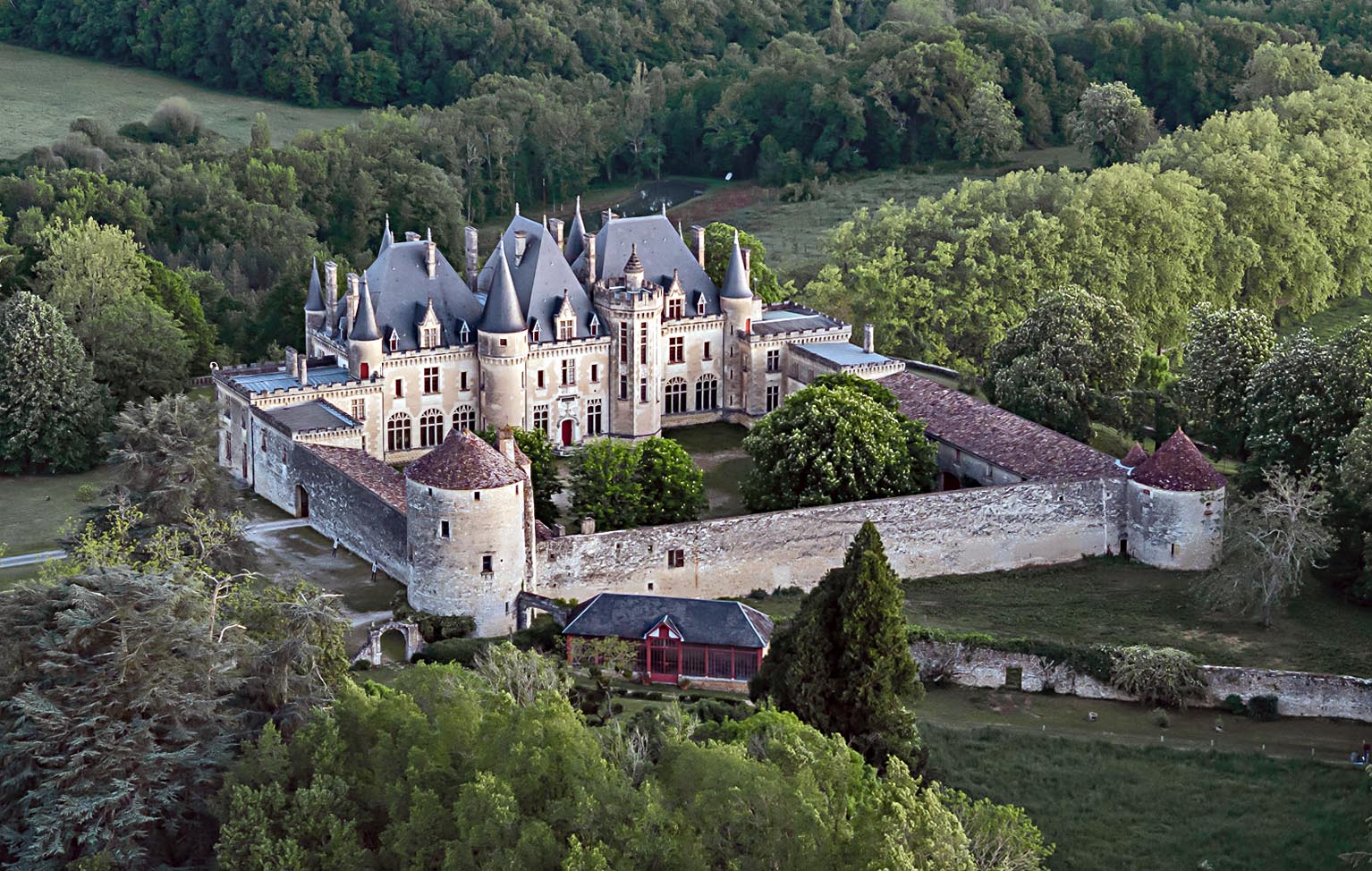
Dordogne, New Aquitaine, France
Michel Eyquem, Seigneur de Montaigne
a Philosopher, Essayist, Statesman, Peacemaker and Modérateur
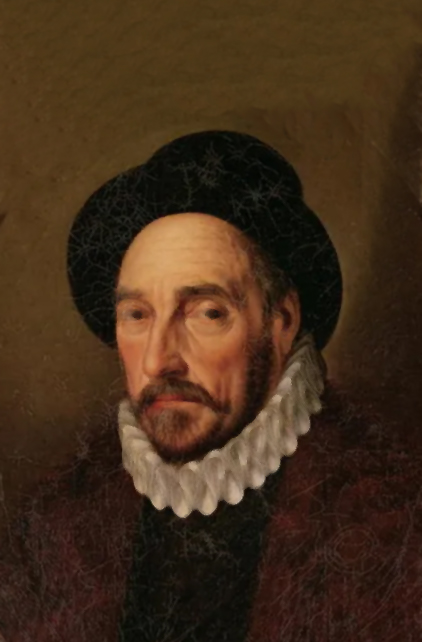
Michel Eyquem, Seigneur(#) de Montaigne (1533-1592), commonly known as Michel de Montaigne, was a leading figure of the French Renaissance. He is best known for the "Essais", a work that combines personal experience with philosophical reflection and that helped establish the essay as a recognised literary form.
In the sixteenth century, Montaigne was known primarily as a statesman, judge, and mediator rather than as a man of letters. His tendency to digress into personal narrative was often criticised as a departure from the formal conventions of his age, and his declaration that "I am myself the matter of my book" was taken by some contemporaries as evidence of excessive self-focus; an expression of undue self-regard. Over time, however, he came to be recognised as a representative of late Renaissance intellectual openness and critical inquiry. His sceptical motto, "What do I know?" (Que sais je?), captures the reflective and questioning disposition that defined both his public conduct and his writing.
Montaigne was born in the Guyenne (##) (Aquitaine) region of France, on his family's estate, the Château de Montaigne, in what is now Saint Michel de Montaigne near Bordeaux. His family was prosperous and possessed considerable wealth. His great grandfather, Ramon Felipe Eyquem, made his fortune as a merchant and purchased the estate in 1477, acquiring the title of Seigneur (Lord) of Montaigne. Montaigne's grandfather and father extended the family's standing through public service, securing a place within the noblesse de robe (the administrative nobility). His father, Pierre Eyquem, Seigneur of Montaigne, served as mayor of Bordeaux and later as a French Catholic soldier in Italy.
Although several families in Guyenne bore the patronym "Eyquem", Montaigne's paternal line is sometimes thought to have included Marrano (Spanish and Portuguese Jewish) ancestry. His mother, Antoinette López de Villanueva, was a convert to Protestantism (###) . Her father, Pedro López of Zaragoza, came from a wealthy Marrano (Sephardic Jewish) family that had converted to Catholicism, while her mother, Honorette Dupuy, belonged to a Catholic family from Gascony.
----------------------------------------
Explanatory Box D2
# A seigneur was a feudal lord who held a seigneurie (lordship) as a fief, with jurisdictional rights over land and the people living on it. This title was not a rank of nobility, but a status tied to landholding and feudal right. The seigneur is best understood as a land-based feudal authority, similar to an English lord of the manor, not a peer.
## Guyenne or Guienne was an old French province which corresponded roughly to the Roman province of Aquitania Secunda and the Catholic archdiocese of Bordeaux. The name "Guyenne" comes from Aguyenne, a popular transformation of Aquitania. In the 12th century it formed, along with Gascony, the duchy of Aquitaine, which passed under the dominion of the kings of England by the marriage of Eleanor of Aquitaine to Henry II.
### His mother's conversion: His mother was a Jewish Protestant, his father a Catholic who achieved "wide culture as well as a considerable fortune." Civilization, Kenneth Clark
----------------------------------------
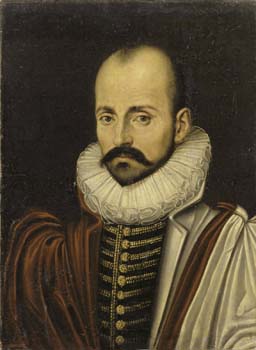
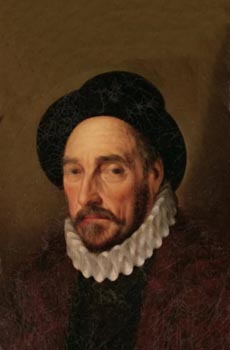
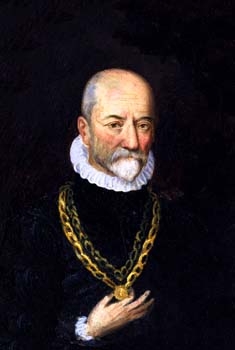
Michel de Montaigne; stages in life.
Education
Montaigne's education began early and followed a deliberately structured programme devised by his father, with advice from humanist friends and senior scholars. Shortly after his birth, he was placed for three years in the care of a peasant family, a decision intended, in his father's words, to bring him "close to the people and to the conditions of those who need our help" (Essais, III, 13). He then returned to the château, where the household's principal aim was for Latin to become his first language. His instruction was entrusted to a German tutor, Horstanus, who spoke no French. His father required the household, including Montaigne's mother and himself, to address the child exclusively in Latin, using only vocabulary Montaigne had already learned. He also acquired some Greek through a method based on games, conversation, and solitary exercises rather than traditional textbooks.
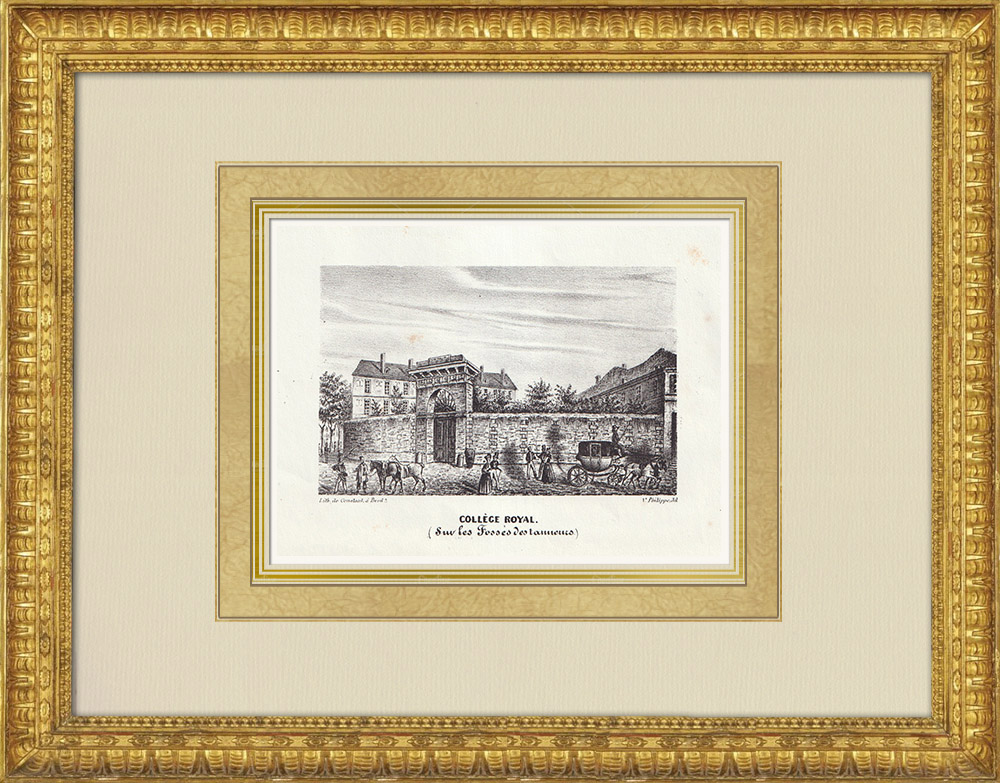 College Royal ( Collège de Guyenne)
 18th Cenntury engraving
The conditions of Montaigne's early upbringing were intentionally designed to cultivate what he later called "liberty and delight", allowing him to "relish duty by an unforced will, and of my own voluntary motion, without any severity or constraint." Music was part of his daily routine: at his father's direction, a musician would wake him each morning by playing various instruments, and an epinettier (a performer on a type of zither (#) regularly accompanied Montaigne and his tutor to relieve fatigue and monotony. Around 1539, he was sent to the prestigious Collège de Guyenne (##) in Bordeaux, then directed by the Latin scholar George Buchanan, and he completed the curriculum by the age of thirteen.
He concluded this first phase of his education in 1546. He later recalled the college's discipline as oppressive and found the instruction only moderately engaging. He then pursued legal studies at the University of Toulouse before entering the local legal profession. Details of his academic and professional progress between 1546 and 1557 remain incomplete, as surviving documentation is limited.
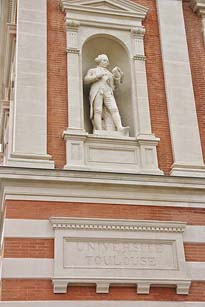
College Royal ( Collège de Guyenne)
and Universite de Toulouse
----------------------------------------
Explanatory Box
(#) Zither is a class of stringed instruments, and the term also refers to a specific subset of instruments of the zither class, most usually the concert or Alpine zithers. The modern instrument has many strings stretched across a thin, flat body.
(##) The College of Guienne was a school founded in 1533 in Bordeaux. The collège became renowned for the teaching of liberal arts between the years 1537 and 1571.
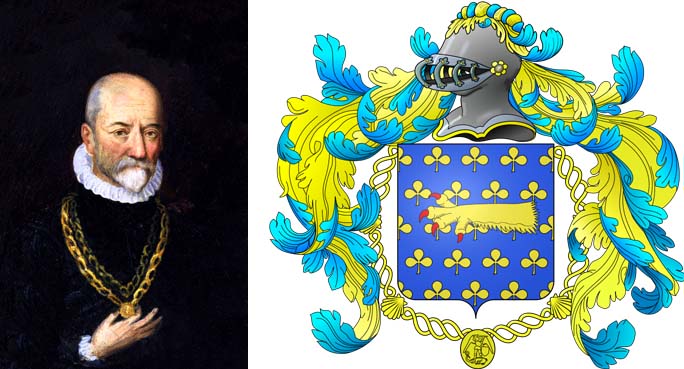
Michel de Montaigne; later in life.
Career and Public Duties
Judicial service (Parlement of Bordeaux): After the dissolution of the Court des Aides of Périgueux in 1557, Montaigne served as a councillor (conseiller) at the Parlement of Bordeaux, one of the kingdom's highest regional courts. Its responsibilities included hearing civil and criminal appeals, registering royal edicts, and exercising judicial oversight within its jurisdiction. Although sources portray him as capable in the role even considering him to have been a high achiever, surviving records do not attribute specific legal reforms or landmark judgments to him; his contribution is therefore best described as sustained institutional service rather than doctrinal innovation.
From 1561 to 1563, Montaigne served as a courtier and moderator to King Charles IX, including accompanying the king during the siege of Rouen in 1562. This period coincided with the early phases of the French Wars of Religion. His service indicates personal loyalty to the Crown, his devotion to Catholicism and experience in politically sensitive contexts requiring discretion. Some sources state that, in recognition of this service, he received the collar of the Order of Saint Michael, the highest honour available to French nobility in the sixteenth century. (Lowenthal, Marvin, 1999).
His later reputation as a modérateur during religious conflict suggests that his judicial temperament and his political conduct was marked by prudence and resistance to fanaticism, qualities valued in parliamentary magistrates of the period.
His ethical and Intellectual contribution had been significant yet indirect. Although Montaigne did not reshape parliamentary institutions directly, his Essays exerted a lasting influence on the ethos of public service. He articulated an ideal of measured civic duty, insisting that public office should be exercised conscientiously but without moral self abandonment. He criticised blind obedience, legal formalism divorced from human experience, and ideological rigidity, views shaped by his years within the judicial system. His reflections on justice, custom, and human fallibility provided a philosophical critique of institutional authority, grounded in first-hand experience.
In this sense, Montaigne's most enduring contribution lies not in procedural reform but in humanising the conception of public office, portraying the magistrate as a fallible human being rather than an infallible agent of law.
In short, Montaigne's contributions to the French parliamentary system were a service as a senior magistrate in one of France's highest courts, loyal yet moderate engagement with royal authority during civil conflict; and a reflective critique of justice and authority informed by lived institutional experience
Retirement and the Essais (Publication Context)
At his father's request, Montaigne produced the first French translation of the Catalan theologian Raymond Sebond's Theologia naturalis (Natural Theology), completing it shortly after his father's death and publishing it in 1568. In 1595, Sebond's Prologue was placed on the Index Librorum Prohibitorum because it asserted that Scripture was not the sole source of revealed truth.
Around the same period, Montaigne also issued a posthumous edition of the writings of Étienne de La Boétie (Kurz, Harry 1950).
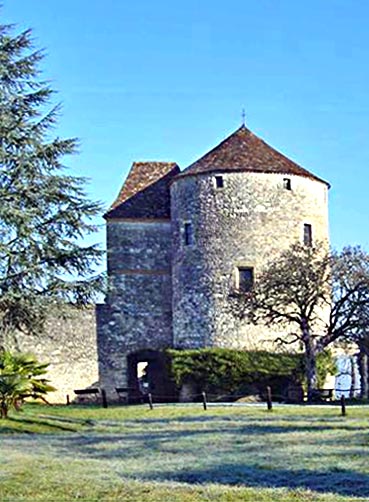
In 1570, Montaigne sold the parliamentary seat he had inherited in the Bordeaux Parlement and returned permanently to the family estate, the Château de Montaigne, thereby assuming the title of Seigneur of Montaigne . Not long after his return, he suffered a severe riding accident on the château grounds when a companion's horse collided with him at full speed, throwing him violently to the ground and leaving him briefly unconscious. His recovery was protracted, and contemporaries believed he had come close to death. The experience left a profound impression on him, and he reflected on it extensively in his later writings.
After the riding accident, Montaigne resigned his magistracy in Bordeaux. His first child was born and died within a few months, and by 1571 he had withdrawn from public affairs. He retired to the tower of the château, his so called "citadel", where he lived in near-complete seclusion from social and domestic life and devoted himself to reading, reflection, and the composition of the Essays.
Montaigne's library, installed in the tower of his château, became his principal refuge. In this circular room, lined with roughly fifteen hundred volumes and marked by Greek and Latin inscriptions, he
composed the Essais, conceived as exercises in reflection, examination, and the testing of his own judgment. Between 1571 and 1580 he wrote the first two books, which were published in Bordeaux in 1580.
On the occasion of his thirty eighth birthday, marking the beginning of his withdrawal from public life, Montaigne had the following inscription placed along the upper cornice of the library shelves in his study:
"In the year 1571, at the age of thirty eight, on the last day of February, his birthday, Michael de Montaigne, long weary of the servitude of the court and of public employments, while still entire, retired to the bosom of the learned virgins, where in calm and freedom from all cares he will spend what little remains of his life, now more than half run out. If fates permit, he will complete this abode, this sweet ancestral retreat; and he has consecrated it to his freedom, tranquillity, and leisure." (see Richard L. Regosin)
The inscription records his intention to dedicate this period to study and writing, framing his retreat not as withdrawal but as a conscious dedication to study, contemplation, and literary labour.
Travels, Mayoralty, and Later Public Life
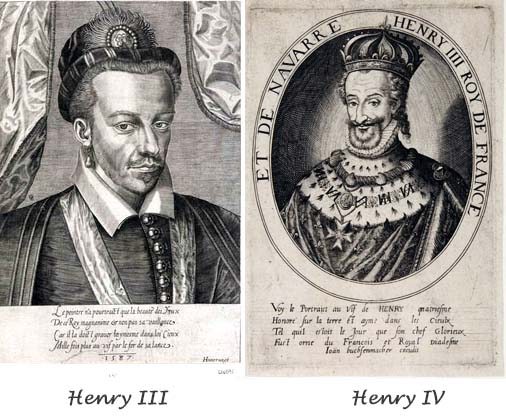
During the French Wars of Religion, Montaigne, a Roman Catholic, was regarded as a conciliatory figure, earning the confidence of both King Henry III and the Protestant Henry of Navarre, who later converted to Catholicism.
In 1578, after a lifetime of robust health, Montaigne began to suffer from painful kidney stones, an ailment that also affected members of his father's family. He generally avoided physicians and medicinal treatments, an avoidance that, in retrospect, may have been prudent. Sixteenth century medicine often involved unhygienic and hazardous procedures or substances, and practices such as bloodletting could place patients at serious risk.
Between 1580 and 1581, Montaigne travelled through France, Germany, Austria, Switzerland, and Italy, partly in search of relief from his condition. He spent time at Bagni di Lucca, where he visited thermal springs. The journey also took on the character of a pilgrimage to the Holy House of Loreto, where he offered a silver relief depicting himself, his wife, and his daughter kneeling before the Madonna; he considered it an honour that the piece was placed upon the shrine's wall. During the trip he kept a detailed travel journal (Journal de voyage), recording regional customs, daily life, and personal experiences, including the size and shape of the kidney stones he managed to expel. The manuscript, not intended for publication, was discovered nearly two centuries later in a trunk in his tower and published in 1774.
During a visit to the Vatican, which he recounts in the journal, Montaigne submitted the Essais for examination by Sisto Fabri (#) , Master of the Sacred Palace under Pope Gregory XIII. After reviewing the work, Fabri returned the manuscript to Montaigne on 20 March 1581. Montaigne had apologised for his references to the pagan notion of Fortuna (##) and for his sympathetic remarks about Julian (###) the Apostate and the references to certain heterodox poets. He was ultimately permitted to revise the text according to his own conscience.
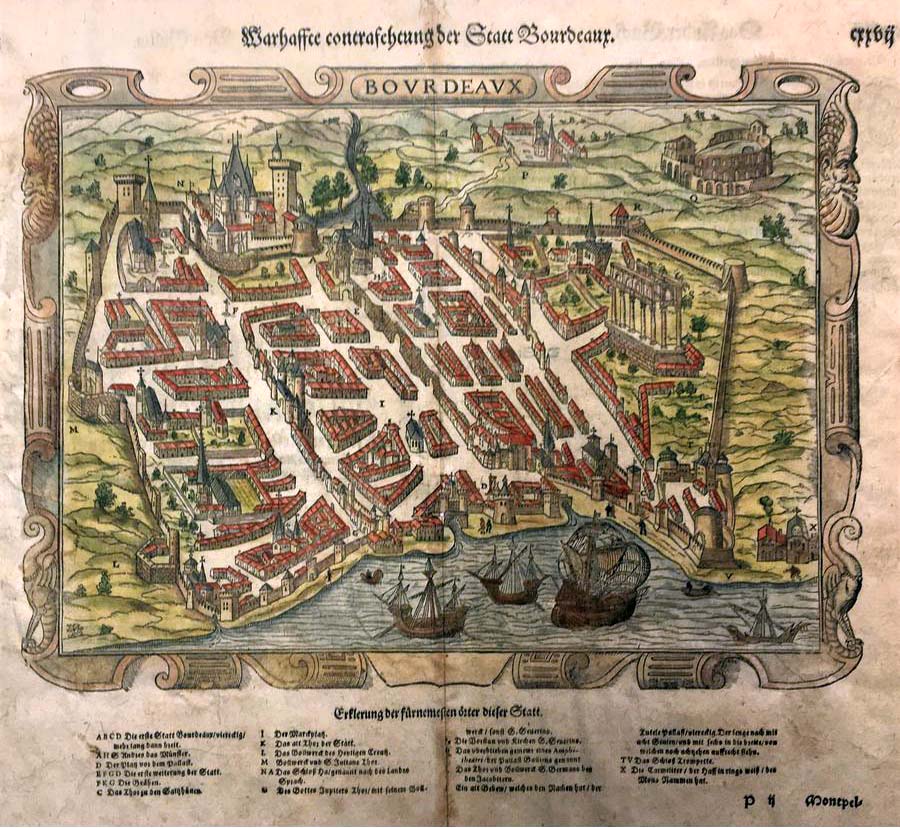
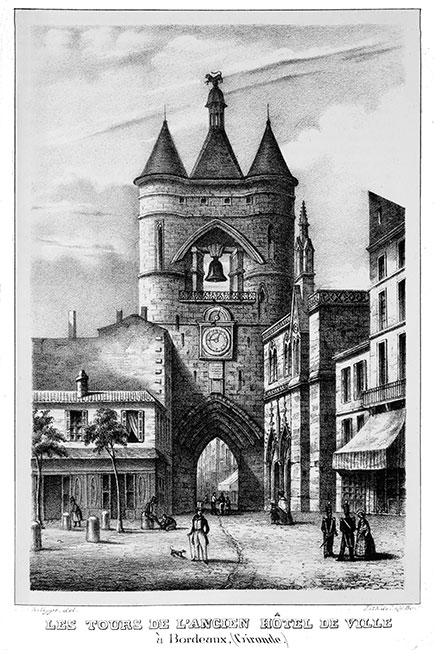
While residing in Bagni di Lucca in Italy, in 1581, Montaigne received message that he had been elected mayor of Bordeaux, as his father had been before him. Although initially hesitant, worried about the unsettled political circumstances in France and to his own deteriorating health, he accepted the office at the urging and the insistence of King Henry III. Re elected in 1583, he served until 1585, continuing to mediate between Catholic and Protestant factions. During the final months of his second term, the bubonic plague struck Bordeaux with catastrophic force, ultimately claiming nearly one third of the city's inhabitants. Throughout this crisis, Montaigne played an important and successful role in maintaining a precarious equilibrium between the Catholic majority and the influential Protestant League.
Montaigne simultaneously pursued his literary work, continually expanding, revising, and supervising new editions of the Essais. In 1588 he completed the third book. During a journey to Paris that same year, he was twice arrested and briefly imprisoned by members of the Protestant League because of his loyalty to Henry III. While in Paris, he oversaw the publication of the fifth edition of the Essays, the first to include the thirteen chapters of Book III, together with substantially augmented versions of Books I and II. It was also during this visit that he met Marie de Gournay , a young writer who admired his work with exceptional devotion. She later became his editor and "literary executrix", and Montaigne referred to her affectionately as his "covenant daughter".
Following the assassination of Henry III in 1589, Montaigne sought to promote a political settlement that would bring an end to the ongoing civil strife. Despite his personal distaste for the Reformation, he supported Henry of Navarre, who would later become Henry IV, believing that national unity and civil peace should take precedence over confessional allegiance. In doing so, he aligned himself with the politiques (*), the faction that prioritised stability, royal authority, and the common good above sectarian divisions (Desan, Philippe, 2016).
----------------------------------------
Explanatory Notes
# Sisto Fabri (1540-1594) was an Italian Dominican friar, theologian, and canon lawyer whose career placed him at the intellectual centre of the late Renaissance Church. Born in Villa Basilica near Lucca, he entered the Dominican Order in 1556 and quickly distinguished himself as a teacher and administrator. Fabri was appointed Master of the Sacred Palace in 1580, a position that made him the pope's official theologian and the chief censor of religious publications in Rome
## Fortuna is the goddess of luck or fortune in Roman religion. She came to represent life's capriciousness, and was a goddess of fate. In antiquity she was also known by the epithet Automatia …"she who does what she will"). Her Greek equivalent is Tyche.
### Julian (Latin: Flavius Claudius Julianus; 331 - 363 CE) was the Caesar of the West from 355 to 360 and Roman emperor from 361 to 363, as well as a notable philosopher and author in Greek. His rejection of Christianity, and his promotion of Neoplatonic Hellenism and persecution of Christians, caused him to be remembered as Julian the Apostate in the Christian tradition
(####) Marie de Gournay (1565 - 1645) was a French writer, who wrote a novel and a number of other literary compositions, including The Equality of Men and Women (Égalité des hommes et des femmes, 1622) and The Ladies' Grievance (Grief des dames, 1626). She insisted that women should be educated. Gournay was also an editor and commentator of Michel de Montaigne. After Montaigne's death, Gournay edited and published his Essays
(*) During the sixteenth and seventeenth centuries, politiques were Western European statesmen who prioritized the strength of the state above all other organs of society, including religion. During the French Wars of Religion, this included moderates of both religious faiths (Huguenots and Catholics) who held that the country could only be saved by the restoration of a strong monarchy which rose above religious differences.
Commentary, Reflections, and Thoughts on Montaigne's Essais
Accordingly, this page presents and illustrates the life and milieu of this remarkable man. He was an extraordinary modérateur who made a significant contribution during an era marked by the Wars of Religion, plague, tuberculosis, and widespread ignorance.
We are now better placed to understand, reflect upon, and appreciate his contribution to philosophy and, above all, to humanity.
On the next page, we shall develop this commentary further, offering additional reflection on his contribution to the world.
Downloadable PDF file is available on this page.
NAVIGATION BAR
The Thinkers Menu!
-
 Return to Home Page
The Menu Guide to Other Philosophers is on Home Page
Michel de Montaigne
A Modérateur, Médiateur & Pacificateur !
Friendship with Étienne de La Boétie
While serving in the Bordeaux Parlement, Montaigne formed a close friendship with the humanist poet Étienne de La Boétie. Their meeting proved one of the most significant events of Montaigne's life, establishing a bond marked by intellectual affinity, personal closeness, and a rare reciprocity of spirit.
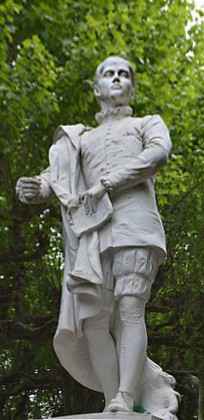 Montaigne later presented their friendship as beginning with an immediate, instinctive recognition, almost a matter of "destiny." He also suggests that La Boétie's Discours de la Servitude Volontaire had prepared the way for their connection, as he had admired the work before meeting its author.
La Boétie's death in 1563 left Montaigne profoundly bereaved. Donald M. Frame, in the introduction to The Complete Essays of Montaigne, suggests that Montaigne's need to communicate after the loss helped prompt the composition of the Essais as a new form of dialogue in which, as Frame observed in 1958, "the reader takes the place of the dead friend."
The encounter with La Boétie, when Montaigne was twenty five, defined this period of his life. La Boétie, then twenty eight, would die at thirty two. Orphaned early, married, and entrusted with delicate political missions, including the pacification of Guyenne during the unrest of 1561, La Boétie was already more established than Montaigne. His best known work, the Discourse on Voluntary Servitude, was initially intended by Montaigne for inclusion in the Essais, but Montaigne later withheld it when Protestant groups began reading the text as an attack on the Catholic monarchy.
Montaigne and La Boétie's friendship became well-known. In the first edition of the Essays, Montaigne wrote:
"If you press me to say why I loved him, I can say no more than because it was he, because it was I. Our souls mingled and blended with each other so completely that they effaced the seam that had joined them."
The Complete Essays of Montaigne, translated by Donald M. Frame, 1958, Book 1, 28.
In the 1595 edition known as the "Bordeaux Copy". Montaigne had added it in the margins of his personal 1588 edition, firstly "because it was he," then in different ink, "because it was I."
Although sociable and surrounded by many friends, Montaigne considered this friendship exceptional, one that only occurs "once every three centuries". Montaigne's admiration for La Boétie's intellectual distinction was matched by deep cultural affinities and a shared ideological harmony, especially in the context of the French Wars of Religion.
"The greatest man I have known... for the natural goodness and capacity of his soul and for a well-born upbringing, was Étienne de La Boétie. It was truly a full soul, and of a beautiful composition in every respect; a classical soul, which would have produced great achievements if fate had allowed it. For it had enriched those fine natural gifts with study and learning."
The Complete Essays of Montaigne,
translated by Donald M. Frame,1958, Book 2,17.
Unfortunately, only four years after their first meeting, in 1563, La Boétie died, possibly of plague or tuberculosis. In the few days preceding La Boétie displayed courage, fortitude and the strength of character which deeply moved Montaigne. Montaigne described this in a letter to his father, then in a Discourse published in 1571 as a postface to La Boétie's collected works.
"There is no action or thought in which I do not miss him. I was already so habituated and accustomed to being second everywhere, that it seems to me I am no longer whole."
The Complete Essays of Montaigne, translated by Donald M. Frame, 1958, Book 1, 28.
Montaigne sought to honour and preserve the memory of La Boétie by publishing La Boétie's writings, many of which had been addressed to leading figures of their age. He then continued an inward dialogue with La Boétie's thought. This dialogue that matured into the work which would become The Essays.
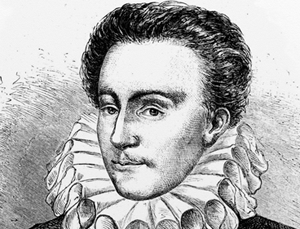
Marriage and Family
Montaigne married Françoise de La Chassaigne in 1565, almost certainly through an arranged union, as was customary among the French nobility in the sixteenth century. Françoise was the daughter of one of his colleagues at the Parlement of Bordeaux and the niece of prosperous merchant families in both Toulouse and Bordeaux.
Françoise de La Chassaigne's value to Michel de Montaigne during his long and frequent absences from home can be described with some confidence, even though surviving sources are fragmentary and often filtered through Montaigne's own famously reserved commentary about his domestic life. When the available evidence is read carefully, it points to a woman who played a quiet but essential role in sustaining Montaigne's household, estate, and freedom to write.
The most direct and important testimony comes from Montaigne himself. In Essay III, 9 ("On Vanity"), he remarks that by his absences he left his wife "the whole government of my affairs". This line is crucial. It is not a rhetorical flourish: it confirms that Françoise de La Chassaigne was entrusted with full responsibility for managing Montaigne's domestic and economic concerns when he was away.
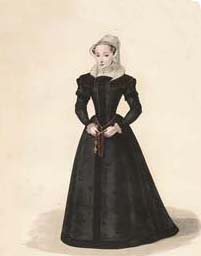
That he could do so depended on someone reliably maintaining the Château of Montaigne, supervising servants, overseeing rents and agricultural production, and handling legal and family matters in his absence. Contemporary norms allowed noblewomen to do exactly this, and Montaigne's own testimony indicates that Françoise fulfilled this role competently.
Historians consistently note that the marriage between Montaigne and Françoise de La Chassaigne was not emotionally central to him, at least as he presents it. They lived largely separate lives, often in separate quarters, which was not unusual for sixteenth-century elite marriages. Montaigne rarely mentions his wife in the Essais, which has sometimes led readers to underestimate her importance.
Yet this silence should not be mistaken for indifference to her usefulness or worth. On the contrary, sources emphasize that Montaigne, deeply occupied with public service and intellectual work, deliberately delegated household management to his wife. In a world where estates could easily fall into disorder, this delegation implies confidence in her judgement, steadiness, and administrative ability.
Françoise de La Chassaigne bore six daughters, only one of whom survived into adulthood. The emotional and logistical toll of repeated infant loss would have been immense. A surviving letter from Montaigne, written after the death of their first child, shows a sober, restrained tone but also acknowledges shared endurance and continuity in domestic life. of Léonor, however, he recorded:
"All my children die at nurse; but Léonore, our only daughter, who has escaped this misfortune, has reached the age of six and more, without having been punished, the indulgence of her mother aiding, except in words, and those very gentle ones."
Léonor later married François de La Tour, and subsequently Charles de Gamaches, having one daughter with each husband.
Françoise de La Chassagne's value becomes clearest when viewed in terms of what Montaigne was able to do because of her reliability, rather than how often he praised her. His writing life depended on freedom from mundane concerns, an unusual privilege even among Renaissance gentlemen. The smooth operation of his estate, finances, and domestic affairs during his travels and retreats was a precondition for the composition and revision of the Essais.
Scholars note that Montaigne's trust in his wife's management allowed him to disengage mentally from practical affairs, confident they would not collapse in his absence. This makes Françoise not a literary collaborator, but an enabler of authorship, one of the invisible figures behind a major work of Western thought.
In short, Françoise de La Chassaigne was valuable to Montaigne not because she appears frequently in his writings, but because she did not need to. Her competence was proven by results rather than commentary. She maintained the household, upheld the family's social standing, managed property, and provided domestic continuity across decades marked by travel, public service, and intense intellectual labour.
Her role exemplifies the paradox of many early modern women of the nobility: indispensable in practice, understated in record. Montaigne's own words, leaving her "the whole government of my affairs", remain the strongest testament to how good and valuable she was during his long absences.
Montaigne's Final Years and Death
Montaigne's later years combined continued literary work with intermittent political engagement and a consistent commitment to moderation during the French Wars of Religion. He remained a figure consulted for counsel and valued for his ability to mediate between opposing factions. His correspondence and the final additions to his work reveal a mind still probing, still reflective, and still attentive to the complexities of human experience
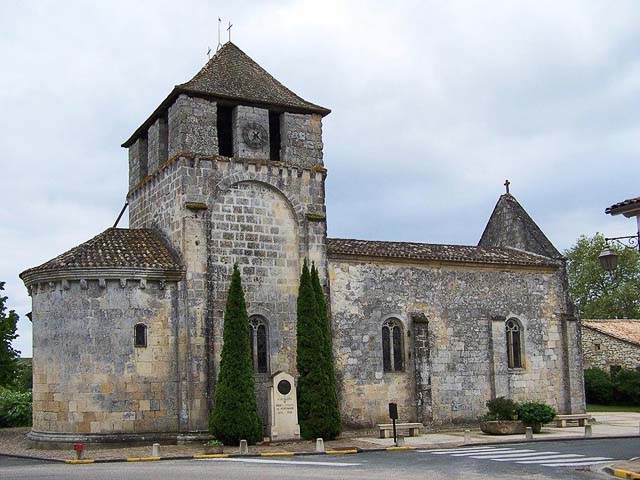
In 1592, at the age of fifty nine, Montaigne died at the Château de Montaigne from a peritonsillar abscess. The illness caused a paralysis of the tongue, an especially poignant affliction for a man who had once written that "the most fruitful and natural play of the mind is conversation. I find it sweeter than any other action in life; and if I were forced to choose, I think I would rather lose my sight than my hearing and voice."
Retaining full possession of his other faculties, he requested that a Mass be celebrated, and he died during its performance. Montaigne was initially buried near the château. His remains were later transferred to the church of Saint Antoine in Bordeaux. (Essays 16) This Church, unfortunately no longer exists.
The movement of his remains, like the long editorial afterlife of the Essais, reflects the sustained efforts of admirers, most notably Marie de Gournay, to preserve and transmit his work.

More ?