THUS SPOKE MY OLD MAN !
Welcome to the Idle Words Said in Passing!
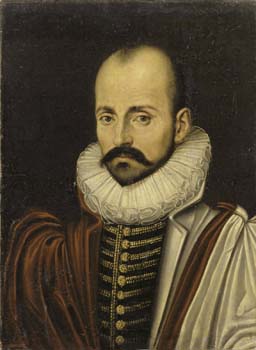
Commentary, Reflections, and Thoughts
on Montaigne's Essais
"What do I know?" (Que sais je?),
Analysis and Observations by Jan Vade
Montaigne's Essais (1580) articulate a distinctive form of Renaissance humanism through a wide-ranging series of brief, deliberately subjective reflections. Drawing on sustained engagement with classical authors, notably Plutarch and Lucretius (#) , Montaigne seeks to portray human beings, and himself in particular, with unreserved candour. The essays therefore function as an inquiry into the conditions, limits, and contradictions of human experience as disclosed through a single life: his own.
In reflecting on the conduct and ideals of prominent figures of his age, Montaigne identifies profound diversity and instability as defining features of human nature. He remarks upon his own unreliable memory; his capacity to resolve disputes and address practical problems without becoming emotionally entangled; his scepticism toward the pursuit of lasting renown and his efforts to detach himself from worldly concerns in anticipation of death. He also records disillusionment with the religious conflicts that dominated his era. Convinced that human beings cannot attain absolute certainty, he develops a distinctly sceptical stance. This position is articulated most fully in his longest essay, the Apology for Raymond Sebond, which signals his embrace of Pyrrhonism (##) and introduces the celebrated question that encapsulates his philosophical outlook: "What do I know? (Que sais-je?)"
______________________________
Explanatory note:
(#) Titi Lucretii Cari De rerum natura libri sex (Montaigne.1.4.4)". Cambridge Digital Library.
(##) Pyrrhonism is an Ancient Greek school of philosophical skepticism which rejects dogma and advocates the suspension of judgement over the truth of all beliefs. It was founded by Aenesidemus in the first century BCE, and said to have been inspired by the teachings of Pyrrho and Timon of Phlius in the fourth century BCE.
______________________________
Montaigne regards his century as marked by dishonesty, corruption, violence, and pervasive hypocrisy. It is therefore fitting that the Essais begin from a largely negative point of departure: the recognition that human life is often governed by appearances and estranged from any stable truth of being. From this initial insight emerges the scepticism for which he is widely known. He questions the very possibility of knowledge and depicts the human being as intrinsically frail, characterised by weakness, failure, inconstancy, uncertainty, and fragmentation. As he observes in the opening essay, humanity is "a marvellously vain, diverse, and undulating thing."
This sceptical orientation is inscribed in the French title Essais, meaning "Attempts," which signals a mode of inquiry grounded not in the transmission of settled truths or assured judgments, but in provisional exploration. The term did not denote a recognised literary genre at the time; rather, Montaigne's work effectively inaugurated the modern understanding of the essay as a concise prose form devoted to reflective investigation.
His scepticism, coupled with a persistent concern for truth, leads him to reject widely accepted opinion and to distrust sweeping generalisations and abstract systems. This disposition turns him toward the only domain that offers any prospect of certainty: concrete, lived experience, and, above all, the phenomenon of his own embodied and thinking self.
This self, with all its imperfections, becomes his primary point of departure in the search for truth. For this reason, Montaigne repeatedly affirms throughout the Essais that "I am myself the matter of my book," a declaration that encapsulates both the method and the philosophical ambition of his project.
He maintains that his identity, his "master form," as he designates it, cannot be understood as a fixed and stable self. Rather, it is inherently mutable and fragmented. The acknowledgement and affirmation of these characteristics, he contends, provide the surest basis for authenticity and integrity, and the only means of remaining faithful to the truth of one's nature rather than conforming to alien appearances.
Sociability and the World
Nevertheless, while insisting that the self must safeguard its freedom against external influences and the tyranny of imposed customs and opinions, Montaigne also affirms the importance of engagement beyond the self. Throughout his writings, as in his private and public life, he demonstrates a sustained commitment to cultivating connections with the broader world of persons and events.
To explain and illustrate this necessary movement between the interior realm of the self and the external world, Montaigne employs the metaphor of the "back room." Human beings, he suggests, possess a "front room," open to the street, in which they encounter and interact with others. Yet they must retain access to a more secluded inner chamber, the back room of the most private self, where they may reaffirm the freedom and resilience of their intimate identity and reflect upon the contingencies of experience.
Assured of an ever-available retreat into the inner self, Montaigne nonetheless recommends active engagement with others, from whom much that is useful and instructive may be learned.
Accordingly, he commends travel, the reading of books, especially works of history, and sustained conversation with friends. Such friends, in his view, are necessarily men. Although none could replace Étienne de La Boétie, he acknowledges the possibility of meaningful and rewarding exchange with men distinguished by "discernment and wit."
With regard to his relations with women, Montaigne writes with a frankness uncommon for his era. He presents marriage as the only unequivocal bond, grounded primarily in considerations of family and posterity, and one in which the individual invests relatively little of the self. Love, by contrast, with its emotional and erotic demands, entails the risk of enslavement and the forfeiture of personal freedom.
Although frequently characterised as a misogynist, Montaigne nevertheless acknowledges that men and women are fundamentally alike in their fears, desires, and efforts to discover and affirm their identities. He suggests that apparent disparities between the sexes arise chiefly from custom and adherence to an antiquated social order. Even so, he does not pursue the possibility of transcending this entrenched division or establishing genuine intellectual equality between men and women.
Montaigne extends his inquiry into human diversity to the Indigenous peoples of South America, whom he came to know through sustained engagement with oral and written travel narratives and, more directly, through his 1562 encounter with three Brazilian visitors brought to France by the explorer Nicolas Durand de Villegagnon. In a gesture of cultural relativism and tolerance unusual for his century, he judges these communities, steadfast in their own nature and marked by cultural dignity, personal integrity, and a refined sense of beauty, to be, in many respects, superior to the peoples of western Europe. Europeans, by contrast, reveal themselves as the true barbarians through the violence of their conquests in the New World and the brutality of their internal conflicts. The suffering and degradation inflicted upon Indigenous populations elicit from Montaigne both indignation and compassion.
For Montaigne, participation in public affairs constitutes another legitimate mode of engagement with the world. It is a responsibility to be discharged honourably and with loyalty, yet never permitted to dominate one's life or erode one's autonomy. This measured view accords closely with the principles of Late Roman Stoicism, with which he was thoroughly familiar.
Education and Learning
Montaigne's writings, most notably his essay on the education of children, articulate a coherent account of selfhood grounded in individual independence and freedom, while simultaneously affirming the formative role of social and intellectual exchange in a well-constituted human life.
For Montaigne, personal integrity and cultivated sociability are not opposing forces but mutually sustaining dimensions of human well-being and success. In his reflections on education, he consistently privileges concrete experience over abstract speculation and prizes the development of sound and independent judgment above the passive accumulation of undigested opinions received from others. This emphasis on lived experience extends to his treatment of the body, which he approaches with unusual candour when he writes openly of bodily functions and dwells on the realities of illness, ageing, and death. Through these interwoven themes, he presents a conception of human formation that unites intellectual discernment, embodied awareness, and sociable engagement.
Montaigne's Essais are suffused with a persistent awareness of mortality. He seeks to internalise the certainty of death in order to free himself from the domination of fear, ultimately accepting death as one of nature's unavoidable demands, an inevitable element of, and limit upon, human life.
Although Montaigne appears to have remained a loyal, if not demonstrative, Roman Catholic throughout his life, he consistently distrusted human claims to possess knowledge of spiritual realities unanchored in lived experience. He declined to speculate about forms of transcendence beyond human comprehension, affirming belief in God while refusing to invoke the divine in ways he regarded as presumptuous, reductive, or detached from concrete existence.
While Montaigne was deeply familiar with classical philosophy, his thoughts arise less from doctrinal allegiances than from sustained meditation upon himself, a reflection he broadens into an account of the human condition and an ethics grounded in authenticity, self-acceptance, and tolerance.
Montaigne's Essais record reflections presented not through an artificially ordered sequence but in the shifting forms in which they arose and returned over the course of his thinking and writing. They do not trace a linear intellectual development or structure; rather, they accumulate continuously, and Montaigne repeatedly affirms the immediacy and authenticity of the testimony Essais offer.
To express their intimate connection with his own nature, he famously describes the essays as his children and, in a striking metaphor, as the excretions of his mind. Just as he refuses to impose a false unity upon the spontaneous movements of thought, he likewise declines to impose a rigid structure upon the Essais. "As my mind roams, so does my style," he observes, and the digressions, meandering developments, and vivid, concrete vocabulary attest to his fidelity to the freshness and immediacy of living thought.
Throughout the work he scatters anecdotes drawn from ancient and contemporary authors, as well as from popular tradition, using them to sharpen his critical engagement with reality. He also interweaves numerous quotations, another mode of conversing with others, namely the authors who surround him in, through the books in his library. Neither anecdotes nor quotations diminish the autonomy of his ideas; rather, they prompt or strengthen a line of reflection and ultimately become integral to the fabric of the book.
The Essais thus embody a profound scepticism toward humanity's dangerously inflated claims to knowledge and certainty, while simultaneously affirming that no greater accomplishment exists than the capacity to accept oneself without contempt or illusion, in full awareness of both one's limitations and one's inherent strengths and abilities.
Reception and Influence
Across the centuries, the Essais have been read in diverse ways, and readers have consistently approached them in search of insights that might speak to their own concerns and yield teachings and answers applicable to their own lives.
Many of Montaigne's contemporaries did not share the admiration of Marie de Gournay. Instead, a number of intellectuals preferred to regard Montaigne merely as a safe and harmless agent of the revival of Late Roman Stoicism. From this preference emerged a long-lasting misunderstanding, interrupted only by the rare discerning reader. The Essais came to be treated as a compendium of philosophical maxims, a repository of "historically sanctioned" wisdom, rather than as the comprehensive expression of a distinctly personal mode of thought and experience.
The fact that Montaigne wrote openly about his most private reactions and emotions, described his physical person, and disclosed his inclinations appeared to many readers unnecessary, shocking, or irrelevant. Likewise, the seeming disorder and disarray of his prose were often judged a flaw to be lamented rather than a mark of authenticity, personal style, and honest observation.
From a philosophical standpoint, during the seventeenth century, an era in which an educated nobility set the cultural standard, Montaigne was often admired chiefly for his portrayal of the cultivated, charming gentleman: a figure marked by serene wisdom and an elegant, understated disenchantment.
In the same period, however, religious writers such as Francis de Sales (#) and Blaise Pascal (##) condemned his scepticism as fundamentally anti-Christian and denounced what they perceived as an immoral, egocentric preoccupation with the self.
In the decades preceding the French Revolution, Montaigne was often regarded as an inflexible thinker. Voltaire and Denis Diderot (*) considered him a forerunner of the Enlightenment (**) .
Jean Jacques Rousseau (^) , by contrast, encountered the Essais in a different and more profound manner. He recognised in Montaigne a mastery of self-knowledge and of literary self-portraiture. Rousseau's influential view casts the Essais as the personal undertaking of a man seeking his own identity and writing candidly about the workings of his reflective nature.
Although earlier misunderstandings and some unjustified criticisms persisted into the nineteenth century, appreciation grew for Montaigne not only as a thinker of considerable originality but also as a writer of the particular, the individual, and the intimate, an unmistakably companionable, familiar, and humane voice. Gustave Flaubert (^^) reportedly kept the Essais at his bedside and recognised in Montaigne a kindred spirit, as would many others in the twentieth century.
The Essais were first translated into English by John Florio (#) in 1603. Among their English-speaking readers have been Francis Bacon, John Webster, William Shakespeare, Lord Byron, William Makepeace Thackeray, Ralph Waldo Emerson, Virginia Woolf, T. S. Eliot, and Aldous Huxley. It is said that Montaigne influenced some of the leading authors in centuries following publication of his Essais, however, such attribution of influences may be a mere speculation. It was common in this period for authors to engage with identical sources and read classical philosophers of antiquity.
Montaigne remains the subject of extensive scholarly study and continues to be widely read across the globe. In an age that may appear as violent and irrational as his own, his rejection of intolerance and fanaticism, together with his lucid recognition of humanity's capacity for destruction and his confidence in the human potential for self-scrutiny, honesty, and compassion, continues to speak persuasively to those who regard him as both guide and companion.
Conclusion
Taken as a whole, Montaigne's Essais present a disciplined scepticism that resists dogma while remaining attentive to the instructive force of experience. By making the self the primary site of inquiry, he offers a model of intellectual honesty grounded in fallibility, openness, and revision. At the same time, his reflections insist that self-possession is compatible with, and even strengthened by, engagement with others through friendship, conversation, and public responsibility. The enduring significance of the Essais lies in this union of self-scrutiny and humane tolerance, which continues to illuminate the challenges of judgment, freedom, and lived truth.
______________________________
Explanatory note:
(#) Francis de Sales, 1567 - 1622) was Bishop of Geneva and is a saint of the Catholic Church. He became noted for his deep faith and his gentle approach to the religious divisions in his land resulting from the Protestant Reformation. He is known also for his writings on the topic of spiritual direction and spiritual formation, particularly the Introduction to the Devout Life and the Treatise on the Love of God.
(##) Blaise Pascal (1623 - 1662) was a French mathematician, physicist, inventor, philosopher, and Catholic writer.
(*) Denis Diderot (1713 - 31 July 1784) was a French philosopher, art critic, and writer, best known for serving as co-founder, chief editor, and contributor to the Encyclopédie along with Jean le Rond d'Alembert. He was a prominent figure during the Age of Enlightenment.
(**) The Age of Enlightenment (also the Age of Reason) was a period in the history of Europe and Western civilization during which the Enlightenment, an intellectual and cultural movement, flourished, emerging in the late 17th century[6]in Western Europe and reaching its peak in the 18th century, as its ideas spread more widely across Europe and into the European colonies, in the Americas and Oceania.
(^) Jean-Jacques Rousseau ( 1712 - 1778) was a Genevan philosopher, writer, and composer. His political philosophy influenced the progress of the Age of Enlightenment throughout Europe, as well as aspects of the French Revolution and the development of modern political, economic, and educational thought.
(^) Gustave Flaubert (1821 - 1880) was a French novelist. He has been considered the leading exponent of literary realism in his country and abroad. According to the literary theorist Kornelije Kvas, "in Flaubert, realism strives for formal perfection, so the presentation of reality tends to be neutral, emphasizing the values and importance of style as an objective method of presenting reality".
(^^) Giovanni Florio (1553 - 1625), known as John Florio, was an English linguist, poet, writer, translator, lexicographer, and royal language tutor at the Court of James I. He is recognised as the most important Renaissance humanist in England. Florio contributed 1,149 words to the English language.
______________________________
This Essay on the Life and Work of Michel de Montainge is available for download here:
Download PDF